
The ₱8.37 Billion That Vanished
In 2025, OFWs sent home a record $35.63 billion to the Philippines — an all-time high, according to Bangko Sentral ng Pilipinas (BSP) data released in February 2026. Of that, $28.49 billion came from land-based workers, $6.94 billion from sea-based.
Hidden inside that money flow is a number nobody asks about. Research published by Wise in March 2025 — and reported by Manila Bulletin and SunStar — found that Filipinos lost ₱8.37 billion to hidden foreign exchange fees in 2023 alone. Roughly ₱3,800 per OFW household per year. Most OFWs never saw a line item for it.
₱8.37 billion sounds like an industry-level abstraction. ₱3,800 per family per year is the kid’s school shoes, two weeks of groceries, half a round-trip ticket home.
Here’s why it happens: remittance services don’t charge one fee. They charge three. The first one is what they shout about on the homepage. The second one is what makes them money. The third one only appears when the money actually arrives.
This guide names those three fees, shows how every major service applies them, and gives you a 60-second protocol for finding all three on any service’s pricing page — today, in 2027, or in 2030.
Reader self-routing:
- Already know the three fees? → jump to §7 to see how each service uses them
- Want the decision framework? → jump to §8
- Want to understand from the ground up? → keep reading
Table of contents
Open Table of contents
- The Remittance Market — and the Money Nobody Asks About
- Hidden Fee #1 — The Fixed Transfer Fee
- Hidden Fee #2 — The Exchange Rate Markup (The Big One)
- Hidden Fee #3 — The Delivery/Payout Fee
- How to Find All 3 Fees on Any Service’s Pricing Page
- 8 Services Decoded — Pricing Anatomy
- Decision Framework — Which TYPE of Service for Which Situation
- What’s Coming in 2026 — And What I’m Building
- The ₱3,800 Rule
- Resources
- About the Author & Disclaimer
The Remittance Market — and the Money Nobody Asks About
Some context for the scale.
In 2025, BSP recorded $35.63 billion in OFW cash remittances — up 3.3% from 2024. That’s the official number that makes the news every February. The number that doesn’t make the news: how much of it never arrives.
The World Bank’s Remittance Prices Worldwide database tracks the global average cost of sending remittances at roughly 6.36% as of late 2025. The UN’s Sustainable Development Goal 10.c.1 — which more than 190 countries have signed onto — sets a target of getting that down to 3% by 2030, and eliminating any remittance corridor that costs more than 5%. Most OFW corridors miss both targets today.
At a 5–6% average cost on $35 billion in annual remittances, OFWs collectively pay roughly $1.75–2 billion a year in remittance fees — and most of that flows to providers who hide their pricing behind layered structures most senders don’t recognize.
Why does this hide so well? Because the fee that’s actually expensive isn’t called a fee.
Hidden Fee #1 — The Fixed Transfer Fee
The fee everyone knows. The least important.
This is the dollar (or HKD or SAR or AED) amount the service explicitly charges you per transfer. It’s the number on the homepage in giant font. “$0 transfer fee!” “Send for just $1.99!”
Here’s why it matters less than you think: on a $200 transfer, a $5 fixed fee is 2.5%. On a $20 transfer, the same $5 is 25%. Fixed fees only dominate at small amounts. For mid- and large-size transfers, this fee is usually the smallest of the three.
The bigger signal is what the fixed fee tells you. A service that brags “FREE TRANSFER!” — Xoom does this on its homepage banner, Remitly does it for first-time users, WorldRemit does it during promo windows — is almost always making up the cost somewhere else. Free is never free in remittance. The “$0 fee” version of a service is usually the one with the highest exchange rate markup.
What different services typically charge as a fixed fee:
- Wise: roughly $1–3 (variable by currency and amount)
- Remitly: $0–4 depending on tier (Economy lower, Express higher)
- WorldRemit: $1–5 typical, occasionally $0 during promos
- Xoom (PayPal): $0 for bank-funded, $5–10 for card-funded
- Western Union: $5–15 variable by corridor and method
- GCash International: low fixed (typically $1–2)
- HSBC Global Money: $0 within the HSBC network
If a service tries to sell you on the fixed fee alone, your next question should be: “What exchange rate are you giving me against the mid-market rate?” Their answer — or evasion — tells you everything.
Hidden Fee #2 — The Exchange Rate Markup (The Big One)
This is the fee that pays for the office building, the marketing, the executive bonuses. It’s also the one almost no service shows you upfront.
Here’s the mechanic.
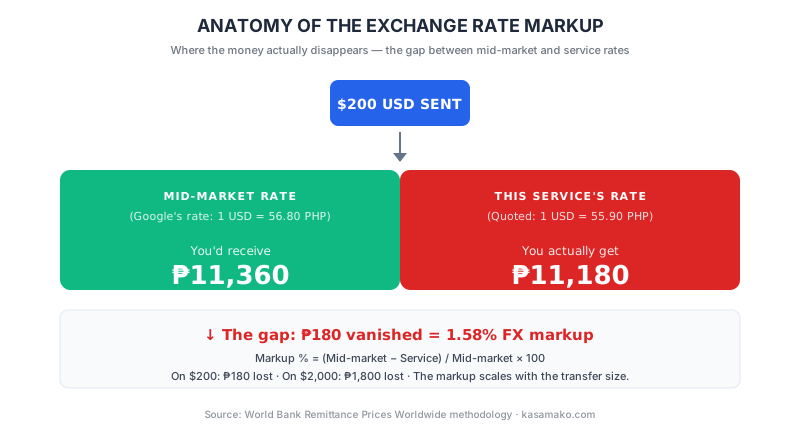
Search Google for “1 USD to PHP” right now. The number you see (something like 56.80) is the mid-market rate — the wholesale rate that banks use among themselves. This is the “true” rate; everyone references it; it’s not what you’ll get.
When you go to a remittance service’s quote page, they’ll show you a different rate — let’s say 1 USD = 55.90 PHP. That’s the service rate — the rate they’re willing to give you.
The gap between those two is the exchange rate markup:
Markup % = (Mid-market rate − Service rate) / Mid-market rate × 100
        = (56.80 − 55.90) / 56.80 × 100
        = 1.58%
On a $200 transfer, that 1.58% is $3.16 lost — typically more than the fixed fee. On a $2,000 transfer, that same 1.58% is $31.60 lost. The markup scales with the transfer size, which is exactly why it’s the fee most worth understanding.
How to find it on any service in 60 seconds:
- Open Google: type “1 USD to PHP” → note the rate
- Open the service’s quote page, enter the SAME amount → note the PHP you’d receive
- Calculate:
(PHP received ÷ USD sent) = effective service rate (Mid-market − Effective) ÷ Mid-market × 100 = markup %
Typical markup ranges across the industry (based on each service’s published pricing approach):
- Wise: typically below 0.6%. Wise publishes a transparency commitment and its fees start from 0.34% on USD-PHP.
- HSBC Global Money: 0% inside the HSBC network, varies outside
- GCash International: typically 0.8–1.5%
- Remitly Economy: typically 0.5–1.2%
- Remitly Express: typically 1.2–2%
- WorldRemit: typically 1–2%
- Western Union: typically 3–5%
- Xoom (PayPal): typically 3–4%
⚠️ Don’t trust these ranges for any specific transfer. Rates change. The point of the markup math above is that you can compute the real number yourself — today, for the exact amount you’re sending, on any service.
This is the fee where ₱8.37 billion vanished in 2023.
Hidden Fee #3 — The Delivery/Payout Fee
The small one. Sometimes shown, sometimes not, sometimes absorbed into Fee #2.
This is the Philippine-side cost of actually receiving the money. It varies dramatically by delivery method:
- GCash crediting: usually free (PH fintech competition keeps this near zero)
- Bank deposit, same network (e.g., BDO-to-BDO): usually free
- Bank deposit, cross-network (e.g., BPI → BDO via PESONet/InstaPay): ₱25–50 per transfer
- Cash pickup at agent (M Lhuillier, Cebuana Lhuillier, Palawan Express, WU agents): typically ₱50–150 per pickup
- Door-to-door cash delivery: ₱150–500 depending on remoteness
The hidden version: some services don’t charge a separate payout fee, they bake it into the FX markup instead. That’s why comparing line-item fees is the wrong comparison. Compare end-to-end: how many pesos does the recipient actually receive for X dollars sent? That’s the only number that matters.
Recipient-side gotcha: if your kabayan’s nearest pickup branch is in another barangay, factor in transportation cost and time. Cash pickup looks “cheap” until you spend ₱100 on tricycle fare and three hours of someone’s day.
How to Find All 3 Fees on Any Service’s Pricing Page
This is the actionable middle of the article. It works for any service, including ones not in §7. Including services that don’t exist yet in 2030.
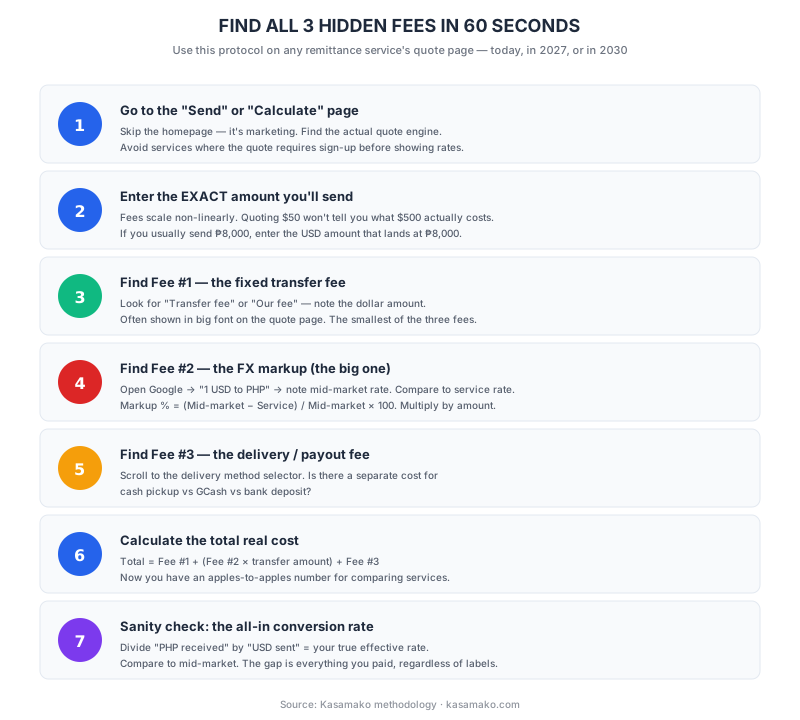
The 7-step protocol:
- Go to the service’s “Send” or “Calculate” page — not the homepage. The homepage is marketing; you want the actual quote engine.
- Enter the EXACT amount you’ll send. Fees scale non-linearly; quoting $50 won’t tell you what $500 costs.
- Find Fee #1: look for “Transfer fee” or “Our fee” — note the dollar amount.
- Find Fee #2:
- Note the exchange rate the service shows (e.g., “1 USD = 55.90 PHP”)
- Open Google in another tab → “1 USD to PHP” → note the mid-market rate
- Calculate the gap as a percentage
- Multiply by your transfer amount = your hidden FX cost in dollars
- Find Fee #3: scroll to the delivery method selector. Is there a separate cost for cash pickup vs GCash vs bank deposit?
- Total real cost = Fee #1 + (Fee #2 × transfer amount) + Fee #3
- Sanity check: divide the “PHP recipient gets” figure by the “USD you send” figure → that gives your true all-in conversion rate. Compare it to the mid-market rate. The gap is everything you paid the service, regardless of how the service labels its fees.
If a service makes step 4 or step 6 hard — if the exchange rate is hidden until checkout, if the “you’ll receive” figure isn’t shown next to the “you’ll pay” figure — that’s the service trying to make hidden fees easier to hide.
Avoid those services.
8 Services Decoded — Pricing Anatomy
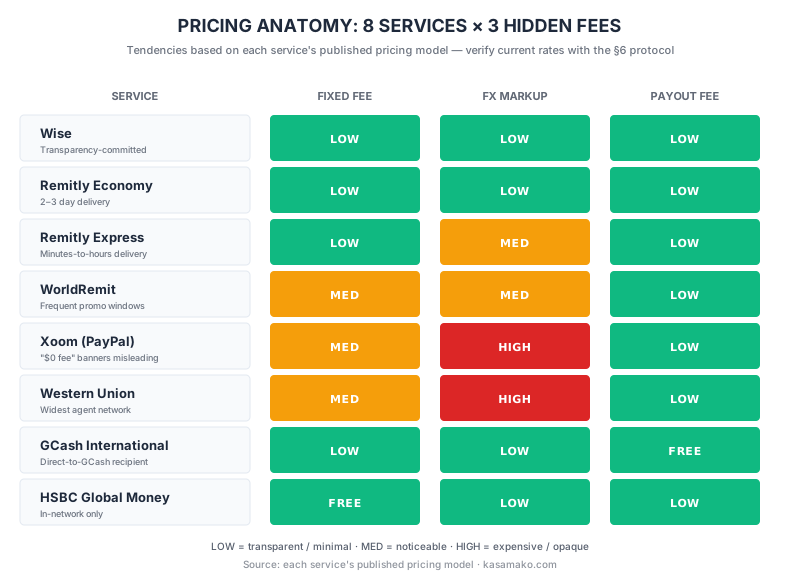
What follows is each major service’s PRICING MODEL — the architecture of how they charge, not specific 2026 rates. Use the §6 protocol to get exact numbers for your transfer today.
Wise
- ✅ Pricing pattern: low fixed fee + 0.34–0.6% FX markup against the mid-market rate. Transparency-committed: every quote shows the mid-market rate alongside the service rate.
- ⚠️ Watch for: recipient must have a bank account or GCash via partner — no direct cash pickup. Weekend rates may carry a small spread.
- 💡 Best fit: bank-to-bank transfers, large amounts, sender who values upfront transparency.
Remitly Economy
- ✅ Pricing pattern: low or $0 fixed fee + ~0.5–1.2% FX markup + 2–3 day settlement. Very popular with OFWs.
- ⚠️ Watch for: first-transfer promo rates don’t repeat. The Economy tier doesn’t include all cash pickup branches.
- 💡 Best fit: bank-to-bank or GCash, willing to wait 2–3 days for delivery.
Remitly Express
- ✅ Pricing pattern: $0–3 fixed fee + ~1.2–2% FX markup + minutes-to-hours delivery. Same provider as Economy, different speed tier.
- ⚠️ Watch for: Express markup is typically 0.5–1 percentage point higher than Economy. You’re paying for speed.
- 💡 Best fit: urgent transfers to GCash or cash pickup.
WorldRemit
- ✅ Pricing pattern: fixed fee + ~1–2% FX markup, frequent promo windows with better rates.
- ⚠️ Watch for: published “promo” rates often revert on the second or third transfer. Read the fine print.
- 💡 Best fit: occasional senders who can time their transfers to promo periods.
Xoom (PayPal)
- ✅ Pricing pattern: variable fixed fee + ~3–4% FX markup (one of the highest in the industry).
- ⚠️ Watch for: “$0 fee” banners are misleading — the FX markup more than compensates.
- 💡 Best fit: honestly, only if you already have funds stuck in a PayPal balance you can’t easily withdraw otherwise.
Western Union
- ✅ Pricing pattern: tiered fixed fee ($5–15) + ~3–5% FX markup + free cash pickup at agents.
- ⚠️ Watch for: in-app rate is often 1–2 percentage points better than walk-in branch rate — use the app even if you’re picking up cash.
- 💡 Best fit: recipient is rural with no bank account and no GCash. Otherwise, digital alternatives almost always beat it.
GCash International (Globe / GCash partner channels)
- ✅ Pricing pattern: low fixed fee + ~0.8–1.5% FX markup + free GCash crediting on the Philippine side.
- ⚠️ Watch for: KYC verification can take 24–48 hours on first send. Do it before you actually need to send.
- 💡 Best fit: HK / KSA / UAE / SG → GCash recipient, small-to-mid amounts.
HSBC Global Money (or equivalent bank-to-bank within network)
- ✅ Pricing pattern: $0 fee for HSBC-to-HSBC within network; standard market FX rate outside the network.
- ⚠️ Watch for: only works if BOTH sender and recipient are HSBC customers. Most aren’t.
- 💡 Best fit: existing HSBC customers, large amounts, low urgency.
Decision Framework — Which TYPE of Service for Which Situation
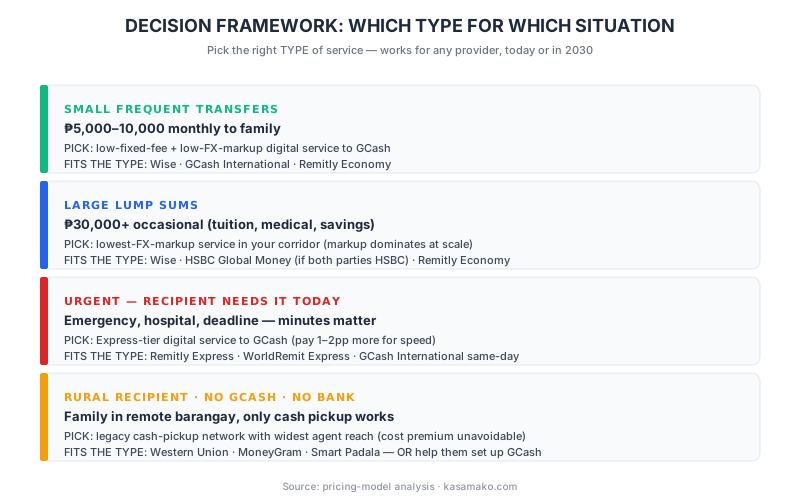
Not “service X is best.” But “for situation Y, the right TYPE of service is Z.” This framework works whether the service is on the list above or doesn’t exist yet.
Small frequent transfers (₱5,000–10,000 monthly)
→ Pick: low-fixed-fee + low-FX-markup digital service to GCash. → Why: at small amounts, fixed fees dominate; minimize the fixed component. → Fits the type: Wise (if recipient has a bank), GCash International, Remitly Economy.
Large lump sums (₱30,000+ occasional)
→ Pick: lowest-FX-markup service available in your corridor. → Why: at large amounts, FX markup dominates. 0.5% on ₱50,000 = ₱250 saved per transfer; a low fixed fee saves only ₱150 or so. Markup wins. → Fits the type: Wise, HSBC Global Money (if both parties are HSBC customers), Remitly Economy.
Urgent — recipient needs it today
→ Pick: Express-tier digital service to GCash. → Why: speed is priced in. Expect to pay 1–2 percentage points more than Economy options. Worth it for emergencies. → Fits the type: Remitly Express, WorldRemit Express, GCash International same-day.
Rural recipient / no GCash / no bank account
→ Pick: legacy cash-pickup network with the widest agent reach. → Why: ubiquity is the only thing that matters here; the cost premium is unavoidable. → Fits the type: Western Union, MoneyGram, Smart Padala. → Better long-term play: help your kabayan or family member set up GCash. Most barangays have e-load shops that double as GCash agents now. The savings from one switch typically recover the setup effort in 1–2 transfers.
Hong Kong-specific notes
If you’re sending from Hong Kong (see our HK 14-Day Rule guide for HK OFW context):
- HSBC HK → HSBC PH: free, ~24 hours, ideal if you have both accounts
- GCash International via Globe partnership is one of the better-priced options in this corridor
- Skip Alipay HK → GCash — convenient but adds ~2% markup vs direct GCash International routes
Saudi Arabia-specific notes
If you’re sending from KSA (see our Saudi 2025 guide for kafala/WPS context):
- The kafala reforms made wage payment through WPS standard — match your remittance currency to your WPS-deposit currency to avoid an extra conversion
- STC Pay → GCash and Mawarid → GCash are now common KSA corridors and competitive on price
- Avoid cash-only money changers — sketchy compliance + the worst rates of any channel
What’s Coming in 2026 — And What I’m Building
Industry trends to watch:
- More direct fintech-to-fintech rails. Direct partnerships (Wise’s InstaPay integration in the Philippines, GCash’s bank partnerships) are gradually pushing fees down. Expect more in 2026–2027.
- Stablecoin/crypto remittance corridors. USDC and USDT remittances to PH are technically faster and cheaper than traditional rails. BSP has cautiously approved several PH-side platforms (PDAX, Coins.ph). The catch: you’re exposed to crypto volatility while the money is “in transit,” and the regulatory ground keeps shifting. Worth watching, not yet worth recommending for most families.
- BSP and World Bank pressure to push corridor costs toward the SDG 3% target. Slow but real.
Kasamako tie-in (honest framing):
This article describes the framework. The tool that automates the framework — type your amount + corridor and get the live delivered amount across all major services in one screen — is on the Kasamako roadmap. The Contract Reviewer ships first; the Remittance Calculator comes after.
Same principle as the Contract Substitution guide: I name the pattern in the article first, then automate the detection.
Join the early-access waitlist if you want notification when either tool ships. No spam, no upsell, no payment required.
The ₱3,800 Rule
If your family has been on the wrong type of service, picking the right type could be worth several thousand pesos a year — for the average OFW household, that’s the school shoes, the new uniform, the medical co-pay you didn’t think you had room for. The math: ₱8.37 billion lost to hidden FX in 2023, divided across roughly 2.2 million OFW households, is about ₱3,800 per family — a conservative estimate of what you stand to recover by using the §6 protocol the next time you send.
Bookmark this. Forward to the kabayan who’s been using the same service since 2018 because their cousin recommended it. The framework is the gift; the specific rates change every quarter.
Resources
Official Data Sources
- BSP — OFW Cash Remittance Statistics — monthly + annual official remittance data
- World Bank — Remittance Prices Worldwide — corridor-level cost data, updated quarterly
- UN SDG 10.c.1 — Remittance Cost Reduction Target — 3% target context
- DMW (Department of Migrant Workers) — OFW services, scam advisories
Research and Reports
- Wise — Filipinos lost ₱8.37 billion to hidden FX fees in 2023
- Manila Bulletin coverage of the same research
- BSP — Latest OFW remittance press releases
Kasamako (in development)
- Join the early-access waitlist — Contract Reviewer + planned Remittance Calculator
Related Reading
- Saudi Arabia’s Kafala System in 2025
- Hong Kong’s 14-Day Rule Trap: 2026 OFW Survival Guide
- Contract Substitution: How to Spot Switched OFW Contracts
- The 40,000 Stranded OFW Crisis: Your Options if Banned
About the Author & Disclaimer
I’m building Kasamako because the OFW community has been underserved by tech for too long. I’m a software developer, not a financial advisor or licensed remittance broker. This article is educational, not financial advice.
Important methodology note: all pricing claims in this article describe each service’s published pricing model as of May 2026. Specific rates change daily — sometimes within the same day. The 3-fee framework does not change, but the percentages you’ll see when you actually quote a transfer may differ from the typical ranges cited above. The point of this article is to teach you to compute the real cost yourself, not to lock in a single ranking.
No affiliate links anywhere in this article. If a remittance service is ever mentioned with an affiliate link in a future Kasamako article, it will be disclosed inline.
If you spot something out of date — a service’s pricing model has shifted, a corridor cost figure is stale — email me at [email protected] and I’ll update it.
Last updated: 2026-05-25