
Last updated: May 2026
Disclaimer: The personal stories in this article are fictionalized composites based on publicly reported situations and common patterns reported by NGOs and Philippine media. Policies and thresholds change frequently — always verify with official sources like HRSD, Qiwa, and DMW before acting on any specific case.
If you’re an OFW in Saudi Arabia — or you’re processing your papers to fly out soon — you’ve probably heard the chatter in your kabayan group chats: “May bago na naman na rules.” And honestly? This time, the changes are massive.
Throughout 2025, the Saudi Ministry of Human Resources and Social Development (MHRSD) rolled out a wave of labor law amendments that touch almost everything: your contract, your ability to switch employers, how your skills get classified, and what happens if you ever end up in a Huroob (absent from work) situation. Some of these changes are genuinely great news. Others? They’ll squeeze workers who aren’t prepared.
I put this guide together because navigating Saudi labor rules shouldn’t feel like solving a puzzle blindfolded. Whether you’re a nurse in Riyadh, a construction foreman in Jeddah, or a kasambahay wondering about your rights, this is for you, kabayan.
⚠️ Important 2026 Update: As of early 2026, DMW has suspended new deployments to Saudi Arabia and several other Middle Eastern countries due to regional tensions and airspace restrictions. If you’re currently in KSA, these labor law changes still apply to you. If you’re waiting to deploy, stay in close contact with your agency and monitor DMW advisories.
The Big Picture: Why All These Changes, and Why Now?
Saudi Arabia’s Vision 2030 plan is reshaping the entire economy. The Kingdom wants to diversify away from oil dependence, build mega-projects like NEOM and the Red Sea Project, and — crucially — put more Saudi nationals into the workforce through Saudization (the Nitaqat quota system).
For foreign workers, that means Saudi Arabia is getting pickier about who it lets in and how they’re classified. But it also means the government is trying to modernize protections: digital contracts, wage transparency, and more freedom to change employers. It’s a double-edged sword, and you need to understand both sides.
1. Your Contract Just Got More Structured
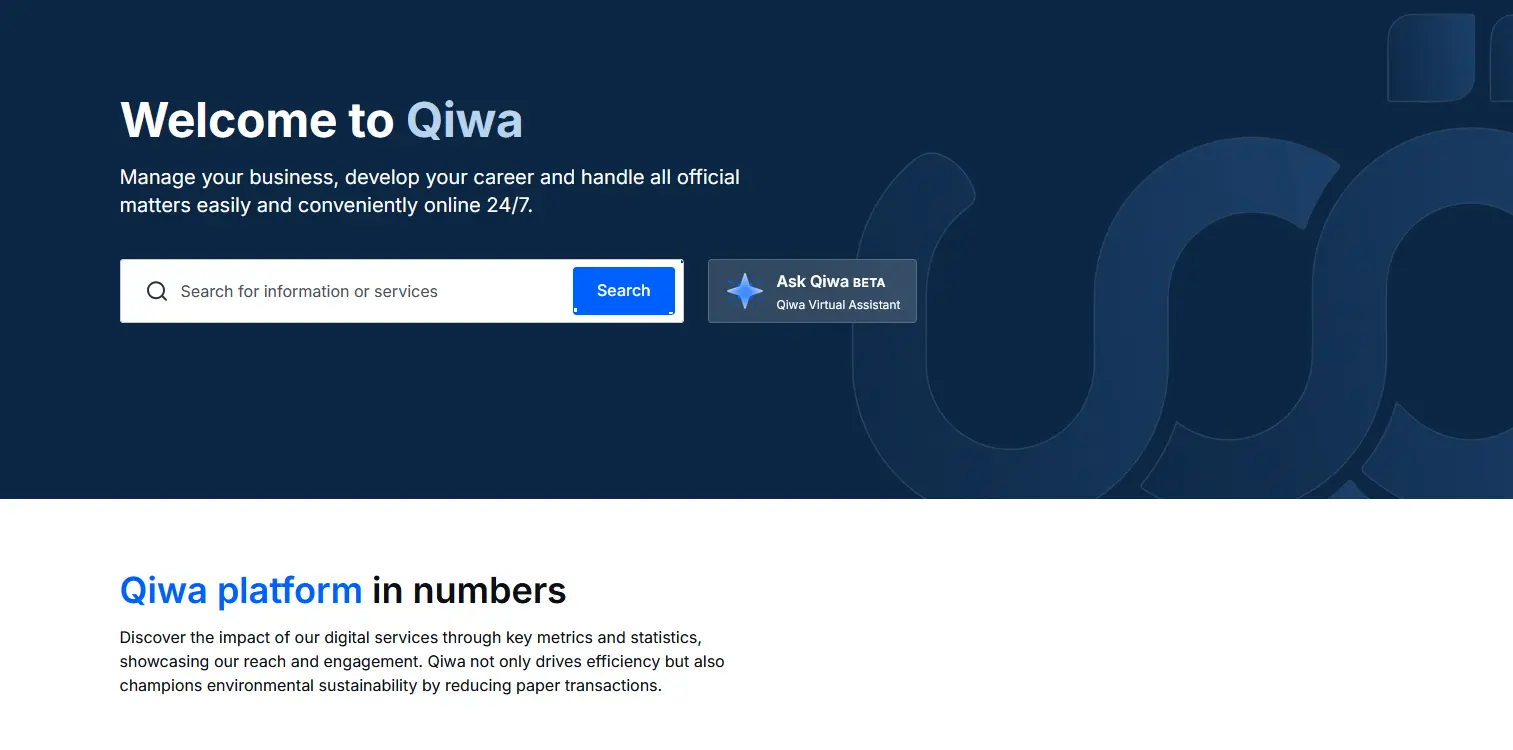
Here’s the deal: as of February 2025, all employment contracts for non-Saudi nationals must be in writing and have a fixed term, and if no duration is specified, the contract defaults to one year from the employee’s start date. These contracts must be registered through the Qiwa platform — Saudi Arabia’s digital hub for managing labor relations.
What this means for you:
Your contract isn’t just a piece of paper your agency hands you anymore. It lives in a government system. That’s actually good news because it means there’s a digital record of what you were promised — your salary, working hours, rest periods, wages, benefits, and allowances all need to be clearly defined in the contract.
The catch: If your actual job doesn’t match what’s registered on Qiwa, you could run into problems during renewals or transfers. So before you sign anything, make sure the job title, salary, and duties on your contract match what’s in the system. Don’t be shy about asking your employer or your POLO (Philippine Overseas Labor Office) for help verifying this.
2. Switching Employers Just Got Easier (With Some Fine Print)
Remember the old kafala days when leaving your employer felt nearly impossible without their blessing? The 2021 Labor Reform Initiative already started chipping away at that, and the 2025 amendments push things further.
Under the updated rules, employees can now directly request transfers without employer approval after one year of service with their current sponsor, using a faster online system that replaces lengthy paperwork processes. The new employer just needs to have a suitable approved position.
The one exception is workers in highly-skilled jobs earning at least SAR 30,000 per month — for this category, transfers still require employer consent due to their critical roles. But for the vast majority of OFWs, the mobility improvements are real.
Pro tip: When your fixed-term contract expires, that’s your cleanest window to move. You’re not “running away” — you’re exercising a legal right. But document everything. Screenshot your Qiwa records, keep copies of your contract, and know your rights before making a move.
3. The Game-Changer: Skill-Based Classification (This One’s Huge)
Okay, pay attention here because this is the reform that’s going to affect almost every foreign worker in the Kingdom.
Starting in mid-2025, Saudi Arabia introduced a three-tier skill classification system for all expatriate work permits. This reform replaces the previous job title-based system with a more structured approach, categorizing workers as high-skilled, skilled, or basic.
High-Skilled — Professionals such as engineers, doctors, and IT specialists, assessed through a points-based evaluation that considers education, experience, and salary. If you score high enough, you get access to better visa privileges, faster processing, and stronger protections.
Skilled — Technicians, supervisors, and administrative personnel who meet wage standards and may need to complete professional accreditation programs.
Basic — Manual labor roles, subject to an age cap of 60 years. This category will face the most restrictions going forward.
The rollout happened in two phases: Phase 1 classified work permits for workers already employed in Saudi Arabia starting July 5, 2025, while Phase 2 applied to incoming foreign workers from August 3, 2025. Workers whose skill level is not accurately classified can submit a request to correct their classification.
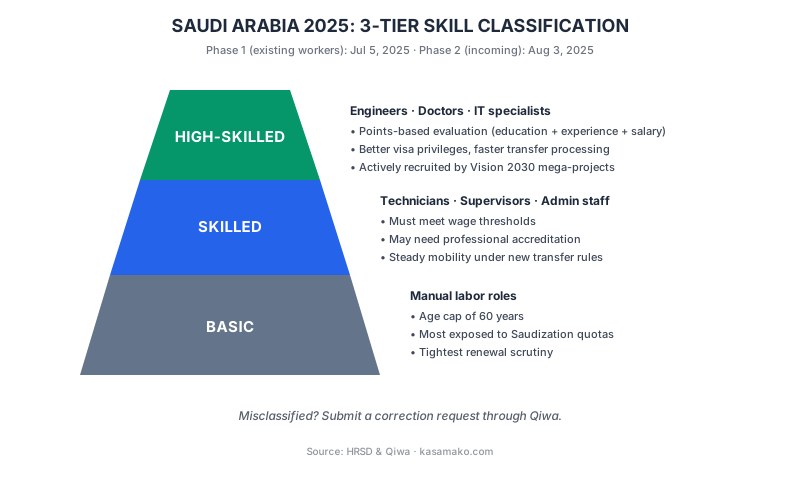
Why this matters so much: Your classification directly affects visa processing, Saudization scoring, and MHRSD inspection ratings. Workers in the “Basic” tier are the most vulnerable to quota restrictions, while “High-Skilled” workers are actively being courted by the Saudi labor market.
4. Huroob Grace Period: A Lifeline for Domestic Workers
Let’s talk about one of the most emotionally charged issues for OFWs: Huroob.
For years, if your employer reported you as “absent from work” (Huroob), you’d essentially be blacklisted. Even if you left because of abuse, wage theft, or unsafe conditions, the system often punished the worker, not the employer. Many kabayan ended up in legal limbo — unable to work legally, unable to leave the country, and terrified of being arrested.
In May 2025, HRSD announced a six-month grace period for domestic workers with irregular legal status, including those reported as absent, allowing them to regularize their status without facing any penalties, effective from May 11, 2025. Eligible workers could use the Musaned platform to correct their status and transfer to a new employer.
The Saudi Ministry then extended the grace period for another six months effective from November 11, 2025. This current window runs through May 11, 2026, after which regular Huroob penalties resume.
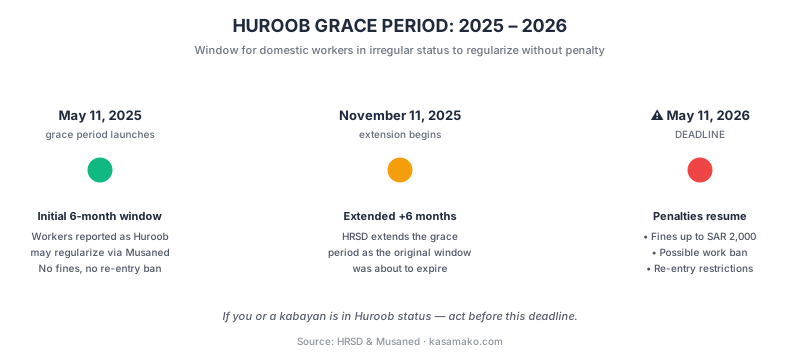
Here’s the critical part: After the deadline, workers who remain non-compliant face fines under HRSD domestic-worker regulations of up to SAR 2,000 per violation, with the possibility of a work ban and re-entry restrictions. Employers who misuse the system can face fines of up to SAR 20,000, a recruitment ban of up to three years, or both.
If you know a Ma’am or a kabayan who’s stuck in this situation, please share this information. The Musaned platform and the Philippine Embassy/POLO can help navigate the process.
DMW has been active on this front too. Migrant Workers Undersecretary Jainal Rasul encouraged OFWs to take advantage of the grace period to correct their legal status.
5. Saudization Pressure: Who Stays, Who Gets Squeezed
Let’s be real: Saudization isn’t going away. The Nitaqat system — which color-codes companies based on what percentage of their workforce is Saudi — keeps getting stricter. The 2025 amendments enhance penalties for non-compliance with Saudization and empower MHRSD to withhold work permit renewals for violations.
What this means for OFWs:
Low-skilled positions in retail, basic services, and some administrative roles are increasingly being reserved for Saudi nationals. If you’re in one of those categories, competition is going to get tougher.
But here’s the other side: The Kingdom’s demand for skilled professionals is growing amid a wave of giga-projects, including NEOM, the Red Sea Project, Qiddiya, and Diriyah Gate. Filipino nurses, medical technologists, IT professionals, and skilled engineers are still very much in demand. The new skill classification system actually benefits workers in these fields because it gives them formal “High-Skilled” status with all the perks.

The takeaway? The days of relying purely on low-skill, low-wage work in Saudi are numbered. Upskilling isn’t just nice to have — it’s becoming a survival strategy.
6. What DMW Is Doing on the Philippine Side
The Department of Migrant Workers has been ramping up monitoring of OFWs in the Middle East throughout 2025 and into 2026.
DMW has been pushing for a joint monitoring system with Saudi Arabia, adopting a “know your employer” approach that would let domestic workers review an employer’s background before leaving the Philippines. Saudi Arabia has already agreed to implement the system.
DMW is also working on properly categorizing workers, particularly distinguishing between domestic helpers and caregivers, since many OFWs are deployed as domestic workers but end up caring for sick adults or children.
Philippine lawmakers have urged DMW to closely monitor Saudi Arabia’s new contract system, emphasizing that legal changes need to be accompanied by thorough monitoring, focused attention, and strong coordination between DMW and OWWA.
7. Real-Life Scenarios: Before and After the 2025 Reforms
Let me walk you through some composite examples based on typical situations that OFWs face. These aren’t specific individuals — they’re realistic scenarios drawn from common patterns in news reports and advisories.
Maria’s Story: From Trapped Nurse to High-Skilled Professional
Before (2024): Maria, 35, is a licensed Filipino nurse with five years of experience working at a hospital in Riyadh. Her contract is tied to her employer under the old sponsorship model. She earns around SAR 8,000 per month. When a better-paying hospital tried to recruit her, she couldn’t switch without her employer’s written NOC, which her employer refused to provide. She felt stuck.
After (2025): When the skill classification system launched in July 2025, Maria’s work permit was reclassified as High-Skilled through Qiwa — her nursing degree, professional license, years of experience, and salary all contributed to her points score. When her fixed-term contract expired, she transferred to a Vision 2030-affiliated medical facility at SAR 15,000+ per month — without needing her previous employer’s approval.
The lesson: If you have the credentials, the new system is designed to reward you. Make sure your qualifications are properly documented and your Qiwa classification accurately reflects your skill level.
Lina’s Story: Escaping Huroob Limbo
Before: Lina, 42, a domestic worker from Manila, left her employer in late 2024 after months of unpaid wages and mistreatment. Her employer reported her as Huroob. Under the old rules, she was effectively a fugitive — unable to work legally, unable to leave the country, and facing a potential permanent ban.
After (May 2025): When the grace period launched, Lina contacted the Philippine Embassy’s POLO office, who guided her through the process on the Musaned platform. A new employer completed the digital sponsorship transfer paperwork. Lina’s Huroob status was corrected, and she had the option to either continue working legally or arrange a proper departure.
If you or someone you know is in this situation: The extended grace period runs until May 11, 2026. Don’t wait until the last day. Contact your nearest MWO (Migrant Workers Office) or POLO, and use the Musaned platform.
Juan’s Story: Contract Clarity Saves a Construction Worker
Before: Juan, 38, a construction project supervisor, signed a contract in 2023 that was vague about his end date and benefits. When his employer delayed wages for three months, Juan wanted to leave but couldn’t because his contract terms were unclear and unregistered.
After (2025): Under the new rules, Juan’s contract is a fixed-term agreement registered on Qiwa. Everything — salary of SAR 7,000, duration, benefits, working hours — is documented digitally. When his contract expired, he transferred to another Saudi construction company at SAR 12,000 per month.
A cautionary note: Another worker in a similar role wasn’t as fortunate. His actual job duties didn’t match the title registered on Qiwa, which caused problems during his skill classification. His employer was fined, and his own visa renewal was delayed. Always verify that your Qiwa profile matches your real job.
The Bigger Industry Picture: Low-Skill vs. High-Skill
Across Saudi Arabia, the pattern is clear. Workers in low-skilled retail and domestic positions are feeling the squeeze from tightening Saudization quotas and skill classification requirements. Meanwhile, demand for Filipino healthcare professionals, IT workers, engineers, and technical specialists remains strong — driven by giga-projects and the Kingdom’s modernization push.
If you’re a balikbayan considering a return to Saudi, or if you’re preparing for your first deployment, the message is: invest in your skills and certifications. The market is shifting, and the workers who adapt will have the most options.
8. Your Action Checklist
If you’re currently working in Saudi Arabia:
- Check your Qiwa profile and make sure your skill classification is correct — if you’ve been misclassified, submit a correction request.
- Verify that your employment contract on Qiwa matches your actual job duties, salary, and working hours.
- If you’re in a Huroob situation, act before the grace period ends on May 11, 2026.
- Keep digital and physical copies of your contract, pay slips, and any correspondence with your employer.
- Know the contact info for the Philippine Embassy, the nearest MWO, and your agency.
If you’re planning to deploy:
- Only go through legitimate, DMW-accredited recruitment agencies.
- Insist on seeing your Qiwa-registered contract before you travel.
- Verify your employer’s Nitaqat status if possible — green or platinum companies are safer bets.
- Invest in professional certifications that will qualify you for “Skilled” or “High-Skilled” classification.
- Monitor DMW advisories closely, especially given current deployment suspensions.
Key Platforms and Resources:
| Platform | Purpose | Link |
|---|---|---|
| Qiwa | Work permits, contracts, skill classification | qiwa.sa |
| Musaned | Domestic worker services, Huroob correction | musaned.com.sa |
| HRSD | Saudi labor law updates | hrsd.gov.sa |
| DMW | OFW advisories, deployment updates | dmw.gov.ph |
| OWWA | Welfare assistance and reintegration | owwa.gov.ph |
| POLO / MWO | In-country labor office | Contact your nearest Philippine Overseas Labor Office or Migrant Workers Office |
Looking Ahead: What to Expect in 2026 and Beyond
The trajectory is clear. Saudi Arabia will continue tightening skill requirements, expanding digital compliance tools, and pushing Saudization further. The Huroob grace period may or may not be extended again after May 2026 — don’t count on it.
For OFWs, the overarching trend is actually positive in many ways: more contract transparency, stronger wage protections, and real mobility between employers. But those benefits come with higher expectations. The Kingdom wants skilled, documented, compliant workers — and the systems are being built to enforce that.
The smartest move any kabayan can make right now? Stay informed, stay legal, and keep leveling up your skills. The rules are changing fast, but for those who are prepared, the opportunities in Saudi Arabia aren’t going away.
Ingat lagi, kabayan. Stay safe out there.
Sources
Saudi Government & Official Platforms
- Ministry of Human Resources and Social Development (HRSD) — labor law announcements and grace-period notices
- Qiwa Platform — contract registration, skill classification, transfer system
- Musaned Platform — domestic worker sponsorship, Huroob status correction
- Vision 2030 Official Site — Saudization, Nitaqat, and economic context
Philippine Government
- Department of Migrant Workers (DMW) — OFW advisories, deployment status, monitoring statements
- Overseas Workers Welfare Administration (OWWA) — welfare and reintegration programs
Legal & Professional Analyses (2024–2025 client alerts)
- DLA Piper — Saudi Arabia Labor Law Amendments (August 2025)
- KPMG Saudi Arabia — Workforce Reforms and Skill Classification (July 2025)
- Dentons — Kingdom of Saudi Arabia Employment Updates (2024–2025)
- Addleshaw Goddard — Saudi Labor Law: What’s Changing
News Coverage
- Gulf News — Huroob grace period launch (May 2025)
- Saudi Gazette — Huroob extension announcement (November 2025)
- Manila Bulletin, Philippine Star, Sun.Star — DMW statements and OFW reporting (2025–2026)
Related Reading
- The 40,000 Stranded OFW Crisis: Your Options if Banned — what to do when Saudi and other Gulf deployments are suspended
- Contract Substitution: How to Spot Switched OFW Contracts
- Hong Kong’s 14-Day Rule Trap: 2026 OFW Survival Guide
- The 3 Hidden Fees in Every Philippines Remittance Service (2026 Guide)
- How to Spot an Illegal OFW Recruiter on TikTok
- POEA Placement Fee: What’s Legal and How to Recover an Overcharge
If you spot an inaccuracy or have on-the-ground experience that contradicts anything above, please contact us. This guide is updated regularly and your feedback helps other kabayan.
Comments