
The Article 11 Test
Article 11, your DMW-verified contract: “Monthly compensation: USD 500.00. Working hours: 8 per day, 6 days per week. One rest day per week.”
Article 11, the contract handed to you on arrival in Dammam: “Monthly compensation: SAR 1,800.00. Working hours: 12 per day, 7 days per week. Rest days as agreed by employer.”
Same clause number. Same employer name. Same date. Not the same wage. Not the same hours. Not the same life.
Welcome to contract substitution — the most common form of fraud in the overseas worker pipeline, and the one most likely to be waiting for you in the first 72 hours after you land.
If you’ve already been deployed, you may already recognize this from your own kasunduan. If you’re about to leave for the first time, you might be about to walk into it. Either way, this guide is built for you.
Below, I’m going to name the six patterns contract substitution actually takes, show you how to spot each one before you sign, and walk you through exactly what to do if it has already happened to you or a kabayan.
- If you’re holding a contract you’re about to sign right now → jump to §5 (the verification protocol).
- If the switch already happened to you → jump to §6 (the response playbook).
- If you’re here to understand the whole game, start here.
Table of contents
Open Table of contents
- What Contract Substitution Actually Is — In Plain English
- The 6 Patterns — Name Them So You Can Spot Them
- Why It Happens — Follow the Money
- Before You Sign — The 8-Point Verification Protocol
- If It’s Already Happened to You — 4 Scenarios
- Country Watchlist — Where Substitution Hits Hardest
- The Numbers — What the Data Actually Shows
- What I’m Building — and Why I Wrote This Article First
- The Cost of Not Checking
- Resources & Contacts
- About the Author & Disclaimer
What Contract Substitution Actually Is — In Plain English
The International Labour Organization (ILO) uses a tight definition: contract substitution is the practice of replacing one contract with another containing less favourable terms — without the worker’s genuine consent. It’s listed under the Deception indicator in the ILO’s official 11 indicators of forced labour, most recently revised in November 2025.
That’s the textbook version. In OFW language: someone hands you a worse contract at a moment when saying no costs more than saying yes.
The law isn’t trying to ban every contract change. There are three legitimate ways your overseas contract can be modified:
- Mutual amendment — you and the employer both want a change, you document it, you sign a clean addendum
- DMW-processed renegotiation — you go through the Migrant Workers Office (MWO, formerly POLO) and get the new terms verified
- Renewal — your original term ends and a fresh contract is signed with full informed consent
Substitution is none of those. It has three telltale features:
- It’s unilateral. You didn’t really agree — you were presented with a fait accompli.
- It happens after you’ve lost leverage. You’re already in Riyadh. Or you’ve already paid the placement fee. Or you’ve already quit your old job in Cebu.
- The new terms are objectively worse in at least one of: salary, hours, rest days, or job title.
It’s not a misunderstanding. It’s not a translation issue. Contract substitution is the deliberate replacement of one contract with a worse one — at a point where you can no longer refuse without serious cost.
The 6 Patterns — Name Them So You Can Spot Them
Most articles about contract substitution stop at “it happens.” Mine goes a level deeper, because substitution doesn’t look like fraud when it happens. It looks like a stack of paperwork on a desk that you don’t have time to read. Naming the patterns is the first step to detecting them.
Here are the six I see most often in OFW casework — across destinations, across industries:
| # | Pattern | What it looks like | How to spot it |
|---|---|---|---|
| 1 | The Airport Switch | Brand new contract handed to you on day 1 in-country, with a “sign now or fly home” threat | Any “sign immediately, no time to read” pressure on arrival |
| 2 | The Multi-Contract Setup | You sign 2 or 3 different versions in Manila (one for DMW, one for the agency’s records, one for the employer) | Agency asking you to sign more than one version without explaining why |
| 3 | The Verbal Promise Gap | Recruiter promised X salary verbally; written contract only commits to legal minimum | ”Don’t worry about what’s on paper, Ma’am will pay you the higher amount” |
| 4 | The Title Downgrade | You signed as “Skilled Nurse” but the destination contract reclassifies you as “Care Aide” with a lower pay band | Compare job titles word-for-word — even one word changed shifts pay scales |
| 5 | The Currency Switch | Contract A says “USD 500/month”; Contract B says “SAR 1,800/month” — converted, the second is less | Force-convert both contracts to PHP before comparing |
| 6 | The Quiet Amendment | Periodic “renewal” or “adjustment” slips handed to you mid-contract, slowly stripping rest days, adding hours, reducing pay | Photograph and file any document presented for signature after deployment |
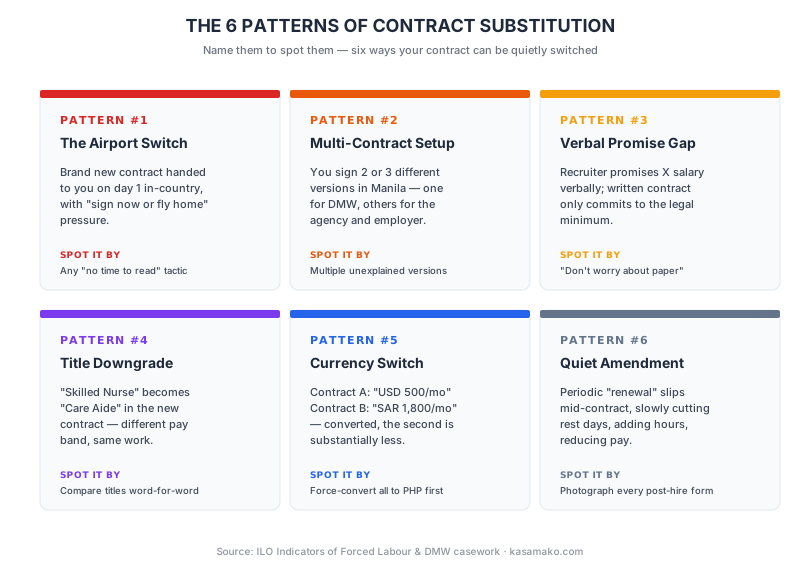
These six don’t usually arrive with red sirens. They arrive as paperwork at a moment when refusing feels harder than signing. The point of naming them is that once you know the pattern, you stop falling for it.
Why It Happens — Follow the Money
The plainest way to understand contract substitution: it exists because the difference between what you were promised and what you actually get gets pocketed by someone else. Usually multiple someones.
- The recruiting agency takes a cut between the headline salary they advertised to attract you and the lower salary the destination employer actually pays
- The destination employer saves on labor cost compared to what was originally budgeted
- You absorb 100% of the financial and legal risk
The numbers are not subtle. According to the ILO’s Profits and Poverty: The Economics of Forced Labour report (March 2024), forced labour generates an estimated US$236 billion in illegal profits every year. The Arab States region — destination for hundreds of thousands of OFWs — accounts for an estimated US$18 billion of that annually. Contract substitution is one of the entry doors into that system, not a separate problem.
The reason it persists isn’t mystery — it’s enforcement geometry. The Philippine DMW can sanction the recruiting agency, but it can’t touch a Saudi or Emirati employer. The destination country’s labor authority can sanction the employer, but it doesn’t track what was signed in Manila. The gap between those two jurisdictions is exactly where the substituted contract lives.
Contract substitution exists because someone profits at every step except yours.
Before You Sign — The 8-Point Verification Protocol
This is the section your future self will thank you for. None of it requires legal training. All of it requires you to be willing to pause, ask questions, and refuse to be rushed.
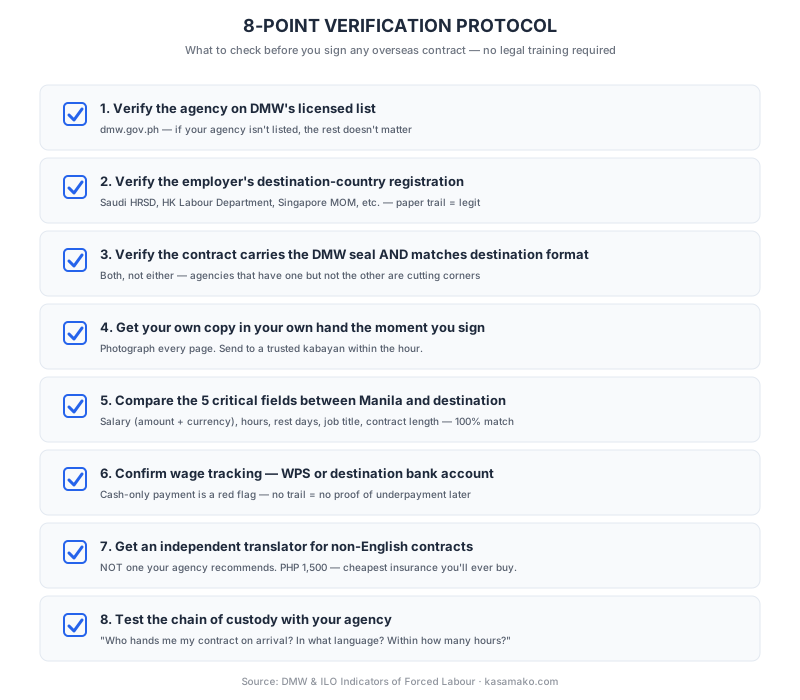
- Verify the agency. The DMW maintains an official list of licensed recruitment agencies at dmw.gov.ph. If your agency isn’t on it, the rest doesn’t matter — walk away.
- Verify the employer. Ask for the employer’s registration with the destination country’s labor authority (Saudi HRSD, HK Labour Department, Singapore MOM, etc.). Legitimate employers have a paper trail.
- Verify the contract template. It must carry the DMW seal AND match the destination country’s standard employment contract format. Both, not either.
- Get your own copy in your own hand. Don’t accept “we’ll give you a copy later.” The moment you sign, photograph every page on your phone. Send it to a kabayan or family member you trust.
- Compare the five critical fields. When you can lay the Manila contract next to the destination contract, these five fields must be 100% identical: salary (amount AND currency), working hours per day/week, rest days per week, job title, contract length. Any discrepancy = substitution.
- Confirm the wage tracking mechanism. Saudi WPS, UAE WPS, HK bank account requirement — whatever applies. Cash-only payment is a giant red flag because it leaves no trail for you to prove you were underpaid.
- Get an independent translator. If your destination contract is in Arabic, Chinese, Hebrew, or any language you don’t read fluently, pay PHP 1,500 to have it translated by someone the agency did NOT recommend. It’s the cheapest insurance you’ll ever buy.
- Test the chain of custody. Ask your agency, literally: “When I land, who hands me my contract? In what language? Within how many hours? In what location?” Honest agencies answer specifically. Evasive answers are a tell.
If It’s Already Happened to You — 4 Scenarios
If you’re reading this past the point of prevention, take a breath. You still have moves. The right move depends on where you are in the timeline.
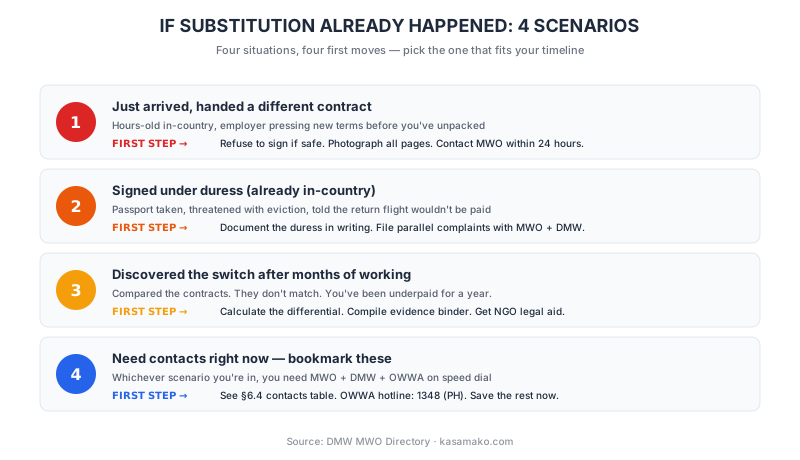
6.1 You Just Arrived and Were Handed a Different Contract
This is the most common scenario — and the one where you have the most leverage, even if it doesn’t feel that way. The employer wants you to sign quickly precisely because they know your bargaining power evaporates over time.
- Refuse to sign on the spot if it is physically safe to do so. You are not legally obligated to sign a contract that materially differs from the one DMW verified.
- Photograph the new contract immediately — every page, including blank ones. Send to a kabayan or family member outside the country within the hour.
- Contact MWO within 24 hours — country-specific numbers are in §6.4 below. Tell them the exact difference between Manila and arrival contracts.
- Use the line that works: “I will report this to DMW, MWO, and OWWA simultaneously, and I want a written acknowledgement of this complaint.” Many employers back down at this point.
6.2 You Signed Under Duress (Already In-Country)
Maybe they took your passport. Maybe Ma’am said “sign or sleep in the street tonight.” Maybe the agency office in your destination country told you they wouldn’t pay your return flight. You signed. That doesn’t make the substitution legal.
- Document the duress. Specific dates, locations, what was said, who said it, who else was present. WhatsApp messages and texts are gold.
- File complaints in parallel — MWO in your destination country AND DMW back in the Philippines. Don’t choose between them.
- Ask OWWA about repatriation. If you want to come home, OWWA has an assistance program for distressed OFWs; you don’t have to fund your own ticket.
- File a wage claim for the difference between the contract you should have been under and the one you’ve been paid under. Keep every payslip.
6.3 You Discovered the Switch After Months of Working
You’ve been working for six months, a year, two years. You finally compared your current contract to the original DMW-verified version. They don’t match. You’ve been underpaid the whole time.
- Calculate the differential. Months worked × (contracted salary − actual salary received) = your minimum claim. Add unpaid overtime if hours also differed.
- Compile your evidence binder: original DMW contract, the substituted contract, every payslip you can find, work schedule records, any messages discussing salary.
- Get legal help. OFW NGOs (Caritas, Mission for Migrant Workers in HK, Migrante International globally) offer free or low-cost legal aid for these cases.
- File on both fronts: a labor complaint in your destination country for unpaid wages, and a DMW complaint at home against the recruiting agency.
6.4 Emergency Contacts — Save These Now
⚠️ Phone numbers and addresses verified against the official DMW MWO Directory (October 2025). If you’re reading this much later, re-verify on dmw.gov.ph.
| Office | Phone | |
|---|---|---|
| MWO Riyadh (KSA) | +966 50 285 0944 | [email protected] |
| MWO Jeddah (KSA) | +966 69 819 720 | [email protected] |
| MWO Abu Dhabi (UAE) | +971 56 270 9157 | [email protected] |
| MWO Dubai (UAE) | +971 50 652 6626 | [email protected] |
| MWO Hong Kong (24h hotline) | +852 5529 1880 | [email protected] |
| MWO Taichung (Taiwan) | +886 9 6653 7732 | [email protected] |
| MWO Tokyo (Japan) | +81 3 6441 0428 / 0478 | [email protected] |
| All other MWO offices | See DMW MWO Directory | — |
| OWWA (PH-local hotline) | 1348 | Welfare & repatriation |
| DMW main | dmw.gov.ph | Complaint filing online |
Country Watchlist — Where Substitution Hits Hardest
Substitution shape-shifts by destination. The agency-employer collusion pattern in Singapore looks different from the airport-switch pattern in Riyadh. Knowing your destination’s dominant variant helps you focus the right verification effort.
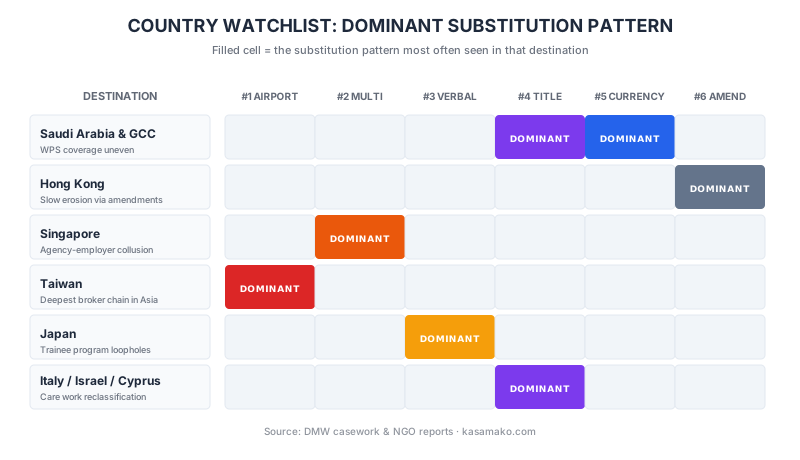
| Country | Dominant Pattern | Why |
|---|---|---|
| Saudi Arabia & GCC | Currency Switch + Title Downgrade | WPS coverage uneven in domestic work; recent kafala reforms haven’t reached basement-level enforcement (see our Saudi 2025 guide) |
| Hong Kong | Quiet Amendment (rest-day stripping) | Standard Employment Contract is strict, so substitution happens slowly through “amendments” rather than airport switches (see our HK 14-Day Rule guide) |
| Singapore | Multi-Contract Setup | MOM verification is strong, but agency-employer collusion creates room for parallel versions |
| Taiwan | Airport Switch + layered broker fees | Deepest broker chain in Asia; substitution often combined with debt bondage |
| Japan | ”Technical Intern Trainee” variant | Documentation is strict, but the TITP program’s structure allows promised conditions to evaporate post-arrival |
| Italy / Israel / Cyprus | Title Downgrade (care work) | Smaller flows but well-documented cases of skilled nurses reclassified as care aides |
Each of these deserves its own deep dive. I’ll write the Singapore guide in a few weeks and link back here. In the meantime: figure out your destination’s dominant pattern, then prioritize the matching verification step from §5.
The Numbers — What the Data Actually Shows
Some numbers to cite next time someone tells you contract substitution is rare:
- 27.6 million people are estimated to be in forced labour globally on any given day, per the ILO’s 2022 Global Estimates of Modern Slavery.
- Contract substitution is explicitly named under the Deception indicator in the ILO’s 11 indicators of forced labour — meaning it’s not just unethical, it’s a defined indicator of forced labour itself.
- Migrant workers are roughly 3× more likely to be in forced labour than non-migrant workers.
- US$236 billion per year in illegal profits from forced labour, per the ILO’s 2024 Profits and Poverty report. The Arab States region accounts for an estimated US$18 billion of that annually.
If you’ve ever been told “this is just how the system works” — the system is a $236-billion-a-year extraction machine. You’re not paranoid for asking questions. You’re rational.
What I’m Building — and Why I Wrote This Article First
Honest disclosure: this article exists today. The tool it argues for does not. Yet.
The reason I wrote this guide before writing a line of tool code — naming six specific patterns instead of waving vaguely at “contract fraud” — is that those six patterns are exactly what I plan to teach the Contract Reviewer to detect. The vision: upload (or photograph) both your Manila-signed contract and your destination contract, and the tool will run the same field-by-field comparison §5 walked you through manually — salary, hours, rest days, job title, currency, contract length. It will flag any divergence in plain English and Tagalog. It will support Hong Kong, Singapore, KSA, UAE, Taiwan, and Japan contracts.
Why am I writing the guides first? Because they teach the rules the tool will encode. And because validating the framework with real OFWs and kabayan — through email, comments, group chats — keeps the eventual tool tied to what people actually need, not what I assume they need.
When the Contract Reviewer ships, it will be free. No paywall, no “Pro” tier. The way it stays free is partnerships with vetted remittance and insurance services — and only when those services actually save OFWs money.
If you want to be among the first to use it when it launches, join the early-access waitlist. I’ll email you when it goes live. No spam, no upsell, no payment required.
The Cost of Not Checking
Contract substitution thrives on one specific moment: the moment between hope and arrival when you stop asking questions. The middle seat over the Pacific. The arrival hall at King Khalid airport. The first night in a stranger’s living room.
That’s the moment recruiters and bad employers count on. They count on you being tired, hopeful, alone, and reluctant to push back.
The defense is mechanical, not emotional. Read the contract. Compare the fields. Verify the agency. Photograph everything. Trust your kabayan, not the silence in the room.
Save this guide. Share it in your group chat — your sister in the next deployment batch, your cousin considering Taiwan, the balikbayan thinking of going back for one more contract. Before any of you sign anything, do the 8-point check.
Contract substitution thrives on one thing: the moment between hope and arrival when you stop asking questions. Don’t let that moment cost you years.
Resources & Contacts
Hotlines & MWO Offices
- Full directory: DMW MWO Directory (October 2025)
- OWWA hotline (PH-local): 1348
- Country-specific numbers verified in §6.4 above
Official Government Resources
- DMW Philippines — licensed agency lookup, complaint filing, MWO directory
- HK Labour Department FDH Section — Hong Kong contract standards
- MOM Singapore Work Permit — Singapore FDW rules
- Saudi HRSD Musaned platform — Saudi domestic worker contract verification
NGO and Advocacy Organizations
- Migrant Rights GCC — Gulf country tracking and case reporting
- Mission for Migrant Workers (HK) — Hong Kong shelter, legal aid
- International Domestic Workers Federation (IDWF) — global advocacy
- Migrante International — Philippine-based OFW advocacy
Reports and Research
- ILO Profits and Poverty: The Economics of Forced Labour (2024) — $236B figure
- ILO Indicators of Forced Labour (2025 revision) — Deception indicator includes contract substitution
- ILO Global Estimates of Modern Slavery (2022) — 27.6 million in forced labour
Kasamako (in development)
- Join the early-access waitlist — Contract Reviewer + AI assistant, launching soon
Related Reading
- Saudi Arabia’s Kafala System in 2025
- Hong Kong’s 14-Day Rule Trap: 2026 OFW Survival Guide
- The 3 Hidden Fees in Every Philippines Remittance Service (2026 Guide)
- The 40,000 Stranded OFW Crisis: Your Options if Banned
About the Author & Disclaimer
I’m building Kasamako because the OFW community has been underserved by tech for too long. I’m a software developer, not a lawyer, not an immigration consultant, and not a labor attaché. This article is educational, not legal advice. Labor laws and consular contacts change. Always verify against the DMW, the relevant MWO, or a licensed migrant worker counselor before making decisions that affect your status or your money.
All statistics and phone numbers were verified against official sources at the time of publication and inline-linked above. If you spot something out of date, email me at [email protected] and I’ll update it.
Last updated: 2026-05-18