
Disclaimer: Ana’s story below is a fictionalized composite based on publicly reported situations and common patterns reported by NGOs and Philippine media — Mission for Migrant Workers, Bethune House, Caritas Hong Kong, and Philippine consulate casework. Rules, phone numbers, and addresses change frequently — always verify with official sources like the Hong Kong Immigration Department, the Philippine Consulate General, or MWO Hong Kong before acting on any specific case.
The Clock Starts the Day Your Contract Ends
Ana’s employer called her into the living room on a Tuesday morning in March 2026. “We don’t need your services anymore,” he said, without looking up from his phone. Her contract still had four months left. But in Hong Kong, that didn’t matter.
She packed her bags that afternoon. Not because she wanted to — but because the law gave her exactly 14 days to either find a new employer or leave the territory. Two weeks. Fourteen days. 336 hours.
She had worked in Hong Kong for seven years. She knew the MTR better than most locals. She could order char siu fan in Cantonese. She had saved enough to send her daughter to college in Cebu.
And now she had two weeks to start over — or lose everything.
Ana’s story isn’t unusual. In 2024 alone, the Hong Kong Immigration Department received over 7,600 extension-of-stay applications from foreign domestic helpers — and rejected more than 1,200 of them. That’s just the slice of OFWs who tried to fight the clock through official channels. The real number facing the countdown is far higher.
If you’re reading this, you’re probably in one of three places: still working under a contract and worried, recently terminated and panicking, or planning to come to Hong Kong in 2026. This guide is for all three of you. Let’s break this rule down — what it really means, and what you can actually do.
Table of contents
Open Table of contents
- What the 14-Day Rule Actually Is — In Plain English
- What This Actually Costs You
- Why This Rule Exists — And Why It’s Unfair
- What You Can Do TODAY — 5 Scenarios
- If You’re Considering Hong Kong in 2026 — Read This First
- Hong Kong vs Singapore vs Middle East: How Bad Is It, Really?
- What I’m Building — And Why I Wrote This Guide First
- The Clock Is Ticking — But You’re Not Alone
- Resources & Contacts
- About the Author & Disclaimer
What the 14-Day Rule Actually Is — In Plain English
Here’s the rule, stripped of legalese.
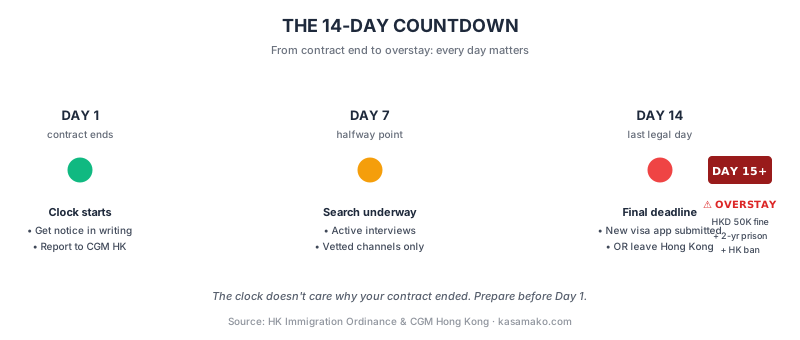
Once your contract as a Foreign Domestic Helper (FDH) in Hong Kong ends — whether it’s a normal expiration, an early termination by your employer, or a mutual agreement to part ways — you have 14 calendar days to either (1) sign with a new employer and have your new visa application submitted, or (2) leave Hong Kong.
Notice what’s missing: there’s no “grace period.” There’s no “we understand you need time to figure things out.” Day 1 starts the moment your contract ends, and day 14 is your last legal day in the territory.
Stay one day longer without a new visa or approved extension? That’s overstaying — a criminal offense under the Hong Kong Immigration Ordinance. The penalties are serious: a fine up to HKD 50,000, imprisonment up to two years, mandatory deportation, and the very real prospect of a future ban on entering Hong Kong for work.
The rule is formally called the “New Condition of Stay,” introduced in 1987 as part of Hong Kong’s first formal Standard Employment Contract for FDHs. The Labour Department’s stated rationale: give workers “sufficient time to prepare for their departure.” The Immigration Department’s stated rationale: prevent “job-hopping” and unauthorized work after contract end.
Three things people get wrong about this Hong Kong immigration two-week rule:
It’s not optional. Some kabayan think “well, my employer fired me unfairly, surely Immigration will give me extra time.” They won’t. Unfair termination is a labor issue. Overstaying is an immigration issue. Hong Kong treats them as completely separate.
The clock doesn’t pause while you’re searching. It doesn’t matter if you’re actively interviewing, if your agency promised you a placement “next week,” or if you’re waiting on paperwork. Day 14 is day 14.
“Job-hopping” suspicion. If Immigration thinks you’ve taken too many short-term contracts, they may reject your new visa application even if you found a new employer in time. The Filipino domestic helper 14-days rule isn’t just about timing — it’s also about how Immigration reads your pattern.
Translation: this is an immigration rule, not a labor rule. Different department, different priorities, different consequences.
What This Actually Costs You
Let’s talk numbers.
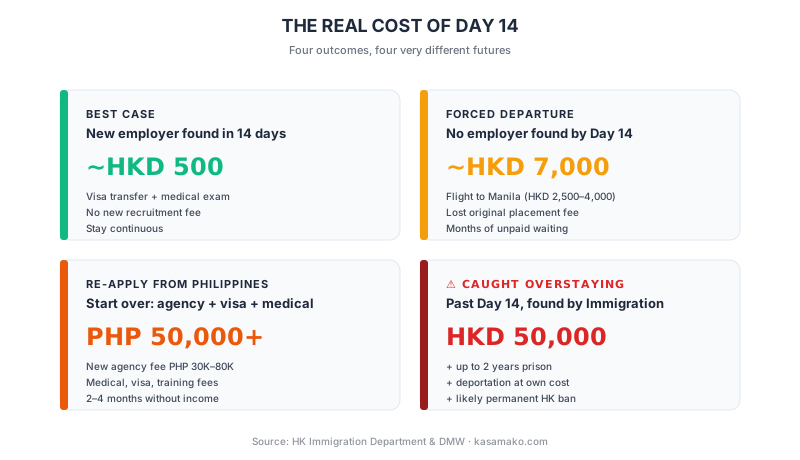
In 2024, the Hong Kong Immigration Department processed 7,625 extension-of-stay applications from FDHs — applications people only file when their original visa is running out and they haven’t yet secured a new employer. More than 1,200 were rejected outright. That’s the official paper trail. The unofficial reality is much larger: NGOs working with domestic workers report that the 14-day rule is among the most common drivers of distress calls and case intake every year.
Here’s what it costs an OFW, in real money:
| What happens | Real cost |
|---|---|
| Overstaying (caught) | HKD 50,000 fine + up to 2 years prison + deportation |
| Forced departure (no new employer in 14 days) | Self-paid flight (~HKD 2,500–4,000) + lost recruitment fee |
| Re-applying from Philippines | New agency fee (PHP 30,000–80,000) + medical + visa + 2–4 months unpaid wait |
| Accepting a worse contract under pressure | Lower salary, abusive employer, illegal terms — because you signed in panic |
That last row is the hidden cost nobody talks about. When you have 14 days, you don’t negotiate. You don’t ask hard questions. You don’t walk away from a contract that smells off. You sign — because the alternative is losing years of building a life in this city.
And then there’s the math you don’t want to do. According to one widely cited study of Filipino domestic workers in Hong Kong, roughly 70% paid placement fees averaging around US$1,459 — about 25 times the legal maximum. If the 14-day rule forces you out and you have to re-apply from home, you pay that fee again. Some kabayan have paid placement fees three or four times across a decade abroad.
The psychological cost is harder to quantify but easier to spot. NGOs like Mission for Migrant Workers and Caritas have been reporting rising distress intake from domestic workers facing termination, with “countdown anxiety” a consistent theme in their casework — the feeling of watching a clock you didn’t start, can’t pause, and can’t outrun.
Fourteen days. That’s less time than most people take to plan a vacation. For an OFW in Hong Kong, it’s the difference between staying and losing everything.
Why This Rule Exists — And Why It’s Unfair
The 14-day rule has been on Hong Kong’s books since 1987. The government’s official justification: prevent “job-hopping” among foreign domestic workers, which they argue would destabilize the labor market and let workers exploit the visa system.
Here’s the part nobody likes to say out loud: that justification only goes one direction.
Your employer can terminate your contract any time they want, for any reason or no reason at all, with one month’s notice (or one month’s salary in lieu of notice). They face no immigration penalty. They lose nothing except the bond they paid the agency — and many of them get most of it back.
You, on the other hand, cannot “terminate and re-sign” to improve your situation. If you leave a bad employer, you’ve got 14 days. If they leave you, you’ve still got 14 days. The clock doesn’t care about the cause.
Compare that to a banker from London moving to Hong Kong on an Employment Visa. If she loses her job, she can typically stay until her visa naturally expires — often months or even years away — while she searches for a new role. Domestic workers don’t get that buffer. They get 14 days. Both pay taxes. Both contribute to this city. Only one of them is treated as disposable.
Or compare it to your kabayan in IT or healthcare on a General Employment Policy visa. They generally keep the remainder of their existing visa to find new work. The distinction isn’t about labor market stability — it’s about which industries Hong Kong wants to retain workers in, and which it sees as easily replaceable.
International pressure to reform has been mounting for decades. As far back as 2005, the UN Committee on Economic, Social and Cultural Rights urged Hong Kong to review the two-week rule; the UN’s anti-discrimination committee (CEDAW) echoed the call in 2006 (reform history overview; see also SCMP feature). Local groups — Mission for Migrant Workers, the Asian Migrants’ Coordinating Body, Bethune House, Caritas — have been lobbying for reform for over two decades. None of that has produced a change in the law.
“The law might change in a few years” doesn’t help you if Ma’am dismisses you on Tuesday.
What You Can Do TODAY — 5 Scenarios
This is the section to bookmark. If you’re in one of these situations right now, scroll to your scenario and follow the steps.
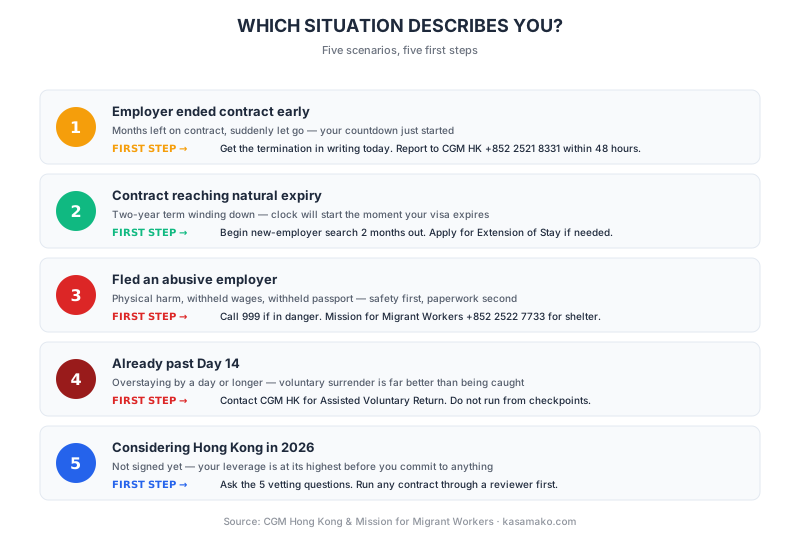
5.1 Your Contract Was Terminated Early
The employer ended things before your two-year contract was up. Maybe Ma’am’s family situation changed. Maybe they’re moving overseas. Maybe — and this is more common than people admit — they just didn’t like you.
Whatever the reason, here’s your sequence:
- Same day or next day: Get the termination notice in writing. If they only said it verbally, send a WhatsApp message confirming what was said and ask for written notice. Screenshots become evidence.
- Within 48 hours: Report to the Philippine Consulate General Hong Kong (PCG HK) at +852 2823 8500 / 8501 / 8502, or visit 14/F, United Centre, 95 Queensway, Admiralty. Bring your contract, passport, HKID, and the termination notice. Registration is free and creates a record.
- Day 1 to Day 10: Search through legal channels only — direct hire by referral, vetted licensed agencies, or NGO-recommended platforms. Don’t use unlicensed agencies promising fast placement; many of them are scams or run illegal placement fee schemes.
- Day 10 to Day 14: Your new employer must submit a fresh Standard Employment Contract to Immigration. Visa approval can take 4–6 weeks, but you need the application in by day 14, not the approval.
5.2 Your Contract Expired Normally
Your two years ended. No drama. But the 14-day rule still applies the moment your visa hits its end date.
- 2 months before contract ends: Start the search. The most expensive mistake OFWs make is treating the 14-day window as their search window. It’s not. It’s your fallback window.
- 6 weeks before: If your current employer is renewing you, get the new contract signed and submitted to Immigration. If not, expand your search aggressively.
- 2 weeks before contract ends: If you don’t have a new contract yet, apply for an Extension of Stay at Immigration Tower (7 Gloucester Road, Wan Chai). You’ll need to show proof of active employment search — agency receipts, interview invitations, anything that demonstrates you’re trying. Extensions are not guaranteed: in 2024, roughly 1 in 6 FDH applications was rejected.
5.3 You Ran Away from an Abusive Employer
This is the scenario where the 14-day rule does the most damage — because it forces people to stay in abusive situations rather than risk the countdown.
- Immediately: Get out, get safe. If there’s been physical abuse or sexual assault, call 999 (Hong Kong police emergency). For non-emergency situations, contact Bethune House Migrant Women’s Refuge (the emergency shelter run by Mission for Migrant Workers) at +852 9338 0035 — they can provide same-day refuge.
- Within 24 hours: Contact MWO Hong Kong (Migrant Workers Office, formerly POLO) on their 24-hour hotline at +852 5529 1880, or main line +852 2866 0640 / 2865 2445. Office at 2902, 29/F, United Centre, 95 Queensway, Admiralty. MWO can file an official complaint and coordinate with PCG HK while you stabilize your status.
- File the labor complaint: At the Labour Department’s Foreign Domestic Helper Section (hotline +852 2717 1771). Unpaid wages, withheld passport, illegal deductions — these are separate violations that strengthen your case.
- Apply for a Special Pass: This is a temporary status that lets you stay in Hong Kong while your case is investigated. It’s not automatic — you have to apply through Immigration with documented evidence. MWO and the Mission for Migrant Workers can guide you through the paperwork.
5.4 You’re Already Past 14 Days
You overstayed. Maybe by a day, maybe by months. Reading this in panic. Take a breath.
- Do not run. Hong Kong’s overstay enforcement is methodical, not aggressive — but if you’re caught at a checkpoint or during a random ID check, the penalties multiply. In 2024, Hong Kong arrested 326 FDHs for illegal employment, prosecuted 267, and convicted 216 — so the system is active.
- Voluntary Departure: Contact PCG HK and ask about voluntary return assistance through OWWA. Surrendering voluntarily typically results in a fine (often reduced based on circumstances) and deportation, but no prison sentence in most cases. Compare that to being caught: fine + prison + permanent ban.
- Future re-entry: After voluntary departure, the standard ban is shorter than after enforced removal. The difference between those two outcomes is largely whether you turn yourself in.
5.5 Emergency Contacts — Save These Now
| Organization | Phone | Address / Notes |
|---|---|---|
| Police (emergency) | 999 | Abuse, assault — call immediately |
| Philippine Consulate (PCG HK) | +852 2823 8500 / 8501 / 8502 | 14/F United Centre, 95 Queensway, Admiralty |
| MWO Hong Kong (24h hotline) | +852 5529 1880 | 29/F United Centre, 95 Queensway, Admiralty |
| MWO Hong Kong (main) | +852 2866 0640 · 2865 2445 | Office hours, Sun–Thu |
| OWWA Emergency | +852 6345 9324 | Welfare & repatriation support |
| Bethune House (MFMW shelter) | +852 9338 0035 | Emergency shelter — abuse cases |
| Caritas Asian Migrant Workers Project | +852 2147 5988 | 131 Sai Wan Ho St., Shaukeiwan |
| HK Immigration FDH Section | +852 2829 3228 | Visa & overstay enquiries |
| HK Labour Dept FDH Hotline | +852 2717 1771 | Or via 1823 (24h): +852 2157 9537 |
If You’re Considering Hong Kong in 2026 — Read This First
If you haven’t signed anything yet, this section might save you years of regret.
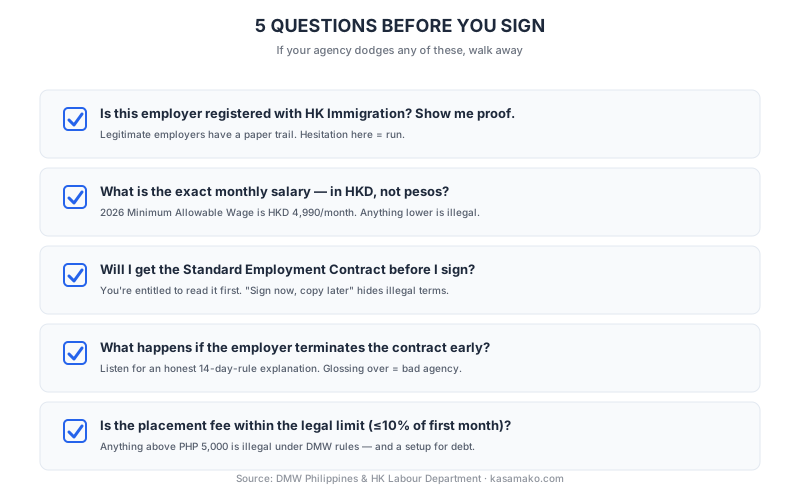
Five questions to ask your agency before you sign anything:
- “Is this employer registered with the Hong Kong Immigration Department? Show me proof.” A legitimate employer has a documented track record. If the agency hesitates, walk away.
- “What is the exact monthly salary — in HKD, not pesos?” As of late 2025, the Minimum Allowable Wage (MAW) was raised to HKD 5,100 per month (up from HKD 4,990), plus a food allowance of at least HKD 1,236 per month. Any contract paying less than the MAW prevailing on your signing date is illegal — and a major red flag.
- “Will I receive a copy of the Standard Employment Contract before I sign?” You’re legally entitled to read it before signing. If they say “sign now, copy later,” that’s how illegal terms get slipped in.
- “What happens if the employer terminates the contract early?” Listen for whether they explain the 14-day rule honestly or gloss over it. Honesty here is the best signal of an honest agency.
- “Is the placement fee within the legal limit?” Under Hong Kong’s Employment Agency Regulations, agencies cannot charge a worker more than 10% of the first month’s salary — that’s about HKD 510 at the current MAW. The penalty for overcharging is a fine of up to HKD 350,000.
The harder truth about placement fees: the law says 10%. The reality on the ground is that one widely cited study found around 70% of Filipino domestic workers in Hong Kong paid placement fees averaging US$1,459 — roughly 25 times the legal maximum. The Philippines’ Department of Migrant Workers (DMW) separately enforces a US$500 monthly minimum wage floor for household service workers deployed abroad — any contract below that is non-compliant on the Philippine side. If your agency invoice doesn’t match the law, you have grounds to push back.
Red flags to walk away from immediately:
- Agency charges placement fees well above HKD 510 (the 10% legal max). Many will — but it’s illegal.
- Contract is English-only with no Tagalog translation offered
- Promised salary “above market” by a suspicious margin
- Agency insists on holding your passport “for safekeeping”
- Verbal promises that don’t match the written contract
Once you’ve done this verification by hand, you’ll have done the same checks I’m building into a Contract Reviewer — a tool that’s currently in development. If you want to use it the moment it ships, join the early-access waitlist. For now, the five questions above are the protocol.
Hong Kong vs Singapore vs Middle East: How Bad Is It, Really?
If you’re weighing destinations, here’s the honest comparison.
Singapore. Not the clean win people assume. Singapore also requires an FDW to leave within 2 weeks after her Work Permit is cancelled — almost identical to Hong Kong’s countdown. The differences are at the edges: Singapore typically requires the employer to give 1 month’s notice, the employer (not the worker) pays the return airfare, a Special Pass is issued to keep her status legal during transition, and the FDW Levy continues to be charged to the employer until cancellation. Where Singapore really differs in the OFW’s disfavor: placement fees are often higher (SGD 3,000+), transfer to a new employer typically requires the current employer’s written release, and overall agency consent is much more entrenched than in Hong Kong.
Middle East (Saudi Arabia, UAE, Qatar). The kafala system. Different beast entirely. In Saudi, your visa is tied so tightly to your sponsor that you historically couldn’t even leave the country without their permission — this is changing slowly after recent reforms (see our Saudi 2025 guide). Hong Kong’s 14-day rule feels almost generous in comparison — and that’s not a compliment to either system.
The pattern across all three. Domestic workers carry the legal risk while employers carry minimal accountability. Hong Kong’s 14-day rule isn’t the worst system in the world. That doesn’t make it right. It just makes it invisible — easier to ignore because it doesn’t make the kind of news that kafala scandals do.
What I’m Building — And Why I Wrote This Guide First
Honest disclosure: this guide exists today. The tool I’d love to point you to does not. Yet.
I’m an independent developer building Kasamako — a free toolkit and AI assistant for OFWs across Asia and the Middle East. The first piece will be a Contract Reviewer: photograph or upload your contract, and it flags red flags in plain English and Tagalog — illegal placement fees, below-MAW salaries, missing rest day clauses, withheld passport provisions, and other patterns we’ve seen in real contracts that hurt real kabayan.
The next piece will be an AI assistant that answers questions 24/7 about your rights, your options, and your specific situation. Whether you’re in Hong Kong worrying about your 14-day clock, in Singapore deciding whether to sign a transfer, or in Riyadh navigating Musaned and Qiwa, the assistant is being designed to understand your context.
Why am I writing the guides before shipping the tool? Because the guides have to teach the rules the tool will encode. If this article saves one kabayan from a bad contract this week, that’s the version of the tool that already exists today — running inside your own head, no app required.
When the tool ships, it will be free. No paywall. No “Pro” tier. The way it stays free is partnerships with vetted remittance and insurance services — and only when those services actually save OFWs money.
Join the early-access waitlist and I’ll email you when it goes live. No spam, no upsell, no payment required.
The Clock Is Ticking — But You’re Not Alone
If you take one thing from this guide, take this: the 14-day rule rewards preparation and punishes panic. Every step you take before you need it — saving emergency funds, building relationships with kabayan in your network, knowing the consulate’s number, reading your contract carefully — buys you time and options when the countdown actually starts.
The 14-day rule won’t change tomorrow. The international push for reform has been going for over 20 years and still hasn’t won. But knowing how to beat the rule? That’s something you can do today.
Save this guide. Share it with the kabayan in your group chat. Bookmark the consulate’s number. Read your contract one more time tonight.
And if you’re already in the countdown — message someone. PCG HK, Caritas, Mission for Migrant Workers, MWO, or a fellow kabayan or balikbayan who’s been through it. You don’t have to handle this alone.
Resources & Contacts
Emergency Hotlines
- Police (life-threatening emergencies): 999
- Philippine Consulate (PCG HK): +852 2823 8500 / 8501 / 8502
- MWO Hong Kong (24h hotline): +852 5529 1880
- MWO Hong Kong (main): +852 2866 0640 · +852 2865 2445
- OWWA Emergency: +852 6345 9324
- Bethune House (MFMW shelter): +852 9338 0035
- Caritas Asian Migrant Workers Project: +852 2147 5988
- HK Immigration FDH Section: +852 2829 3228
- HK Labour Dept FDH Hotline: +852 2717 1771 (or 24h via 1823: +852 2157 9537)
Official Government Resources
- Hong Kong Immigration Department — visa rules, Standard Employment Contract, overstay penalties
- Hong Kong Labour Department — FDH Section — wage standards, working conditions, dispute resolution
- DMW (Department of Migrant Workers, Philippines) — deployment rules, placement fee limits, complaint filing
- Philippine Consulate General Hong Kong — passport, registration, welfare assistance
NGO and Advocacy Organizations
- Mission for Migrant Workers — shelter, legal aid, casework
- Bethune House Migrant Women’s Refuge — emergency shelter
- Caritas Hong Kong — migrant worker programs
- HELP for Domestic Workers — legal and financial advice
- Federation of Asian Domestic Workers Unions (FADWU)
Reports and Research
- HKSAR LegCo Q&A on illegal stay and employment of FDHs (March 2025) — official 2022–2024 statistics
- Domestic Worker Placement Fees in Hong Kong (DWJI) — legal vs actual fee data
- HKSAR MAW & Food Allowance announcement (Sept 2025) — current rates
- UN OHCHR — Hong Kong human rights reviews referencing migrant workers
Kasamako (in development)
- Join the early-access waitlist — Contract Reviewer + AI assistant for OFWs, launching soon
Related Reading
- Saudi Arabia’s Kafala System in 2025
- Contract Substitution: How to Spot Switched OFW Contracts
- The 3 Hidden Fees in Every Philippines Remittance Service (2026 Guide)
- The 40,000 Stranded OFW Crisis: Your Options if Banned
About the Author & Disclaimer
I’m building Kasamako because the OFW community has been underserved by tech for too long. I’m a software developer, not a lawyer, and not an immigration consultant. This article is educational, not legal advice. Immigration rules, MAW figures, and consular procedures change. Always verify current rules with the Hong Kong Immigration Department, the Philippine Consulate General, MWO Hong Kong, or a licensed Philippine migrant worker counselor before making decisions that affect your status.
Phone numbers and addresses were verified against official sources at time of publication. If you spot something out of date, email me at [email protected] and I’ll update it.
Last updated: 2026-05-13