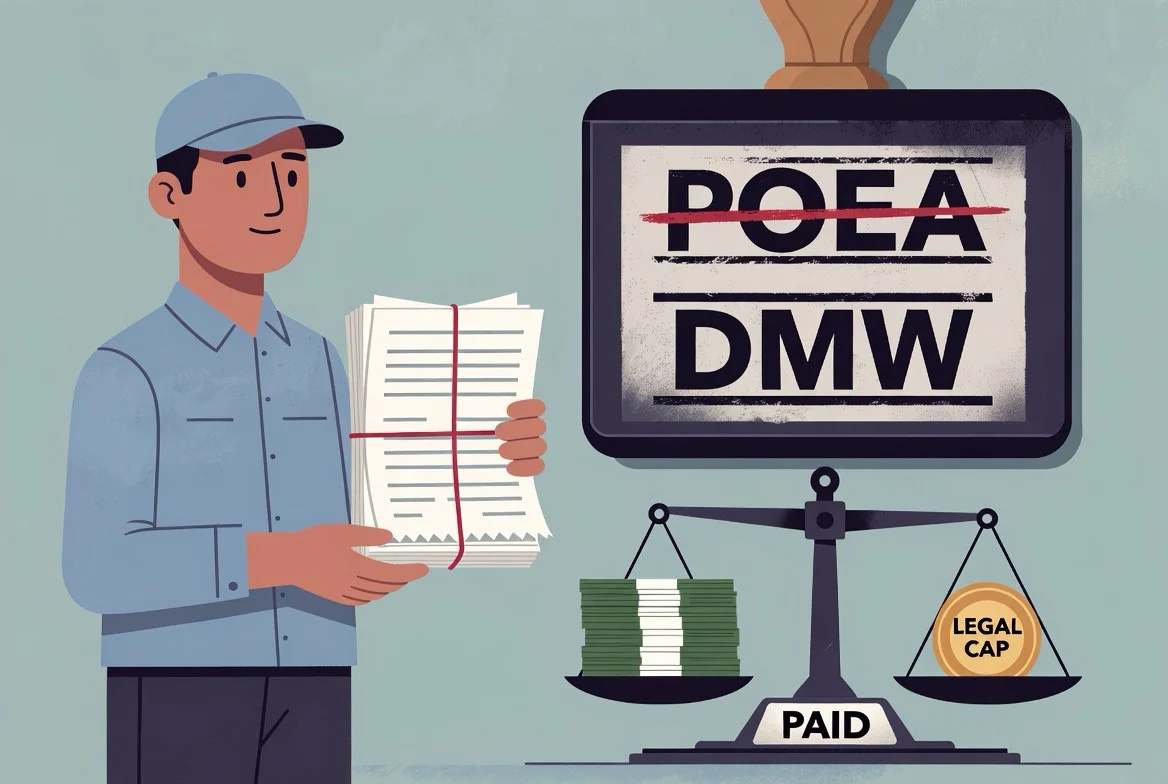
POEA Is Gone. Your Money Question Isn’t.
You typed “POEA placement fee” into Google, and the answers felt slippery — different numbers, old forum posts, nothing that looked official. There’s a reason for that: POEA doesn’t exist anymore. In 2022, the Philippine Overseas Employment Administration was folded into a new agency, the Department of Migrant Workers (DMW). The name on the door changed. The rules about what you can be charged did not.
So the question is still a fair one — and a lot of OFWs are quietly afraid the answer is “you paid too much.” Maybe you paid two months’ salary instead of one. Maybe you paid a “placement fee” for a domestic-worker job that’s supposed to be free. Maybe you paid before you ever saw a real contract.
If any of that sounds familiar, here’s the part nobody tells you: that money may be recoverable, and the system built to give it back already exists. Every licensed agency is required to post a cash bond with the government for exactly this purpose — to pay the claims of workers it shortchanged.
This guide does two things. First, it shows you exactly what you were legally allowed to be charged. Then it walks you, step by step, through getting the difference back.
Jump to what you need:
- Just want to know the legal fee before you pay? → The One-Month-Salary Rule and the jobs that pay zero
- Already paid and not sure it was too much? → Were You Overcharged?
- Sure you were overcharged and want it back? → How to Get Your Money Back
Take a breath. Asking for a refund of an illegal charge isn’t being difficult. It’s using the system exactly as designed.
Wait — POEA Doesn’t Exist Anymore?
Correct, and it’s worth thirty seconds to settle this, because it changes who you go to.
Under Republic Act 11641, the Department of Migrant Workers Act of 2022, the POEA was abolished and merged — along with the overseas labor offices (POLO) and several other units — into a single new department, the DMW. The department absorbed all of POEA’s powers: licensing agencies, regulating recruitment, and handling worker complaints.
Here’s what did not change:
- The placement-fee rules carried straight over. The one-month cap, the timing rules, the no-fee categories — all still in force.
- Republic Act 8042, the Migrant Workers Act (as amended by RA 10022), still defines what counts as illegal collection of fees.
- Your old paperwork is still valid evidence. Anywhere you see “POEA” on an old certificate, contract, or receipt, just read it as “DMW.” Your POEA-era contract and receipts still prove what you were charged.
The practical translation: if you were overcharged, you don’t chase a defunct agency. You go to the DMW — and abroad, to a Migrant Workers Office (MWO), the rebranded POLO.
The name on the door changed. The rule that protects your wallet didn’t. If anything, you now have one department — the DMW — whose entire job is the thing you’re worried about.
What a “Placement Fee” Actually Is (and Isn’t)
Most overcharging hides inside the definition, so let’s separate two things that often get rolled into one scary number.
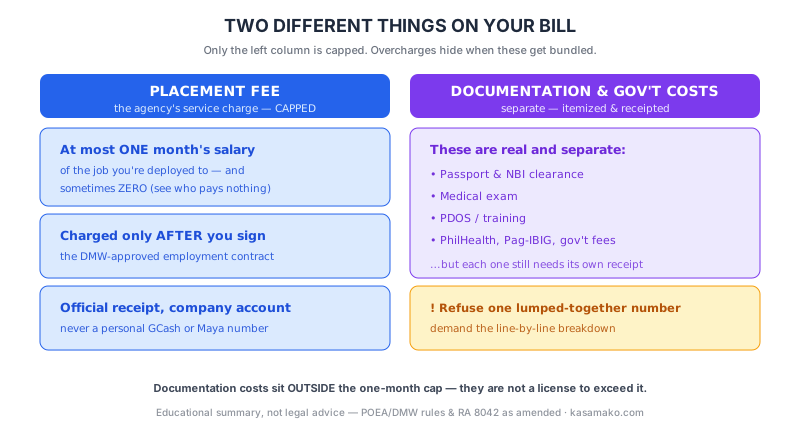
The placement fee is the agency’s service charge for placing you in a job. This — and only this — is what the one-month cap governs.
Not the placement fee are the documentation and processing costs: passport, NBI clearance, medical exam, pre-departure orientation (PDOS), and government contributions like PhilHealth and Pag-IBIG. These are legitimate and separate — the placement fee is exclusive of documentation costs — but each one still needs to be itemized, and each needs an official receipt.
The overcharge trick is bundling. A shady agency hands you one vague “₱120,000 processing fee” so you can’t see that the placement-fee portion blew past the legal cap. Itemization is your right. Ask for the line-by-line breakdown, and ask for a BIR-registered official receipt for every peso — paid to the agency’s company account, never a personal GCash or Maya number.
You can’t tell if you were overcharged until you separate the agency’s fee from the government’s costs. Agencies that overcharge know that — which is why they hand you one big number and hope you never ask for the breakdown.
The One-Month-Salary Rule
Here’s the number you came for.
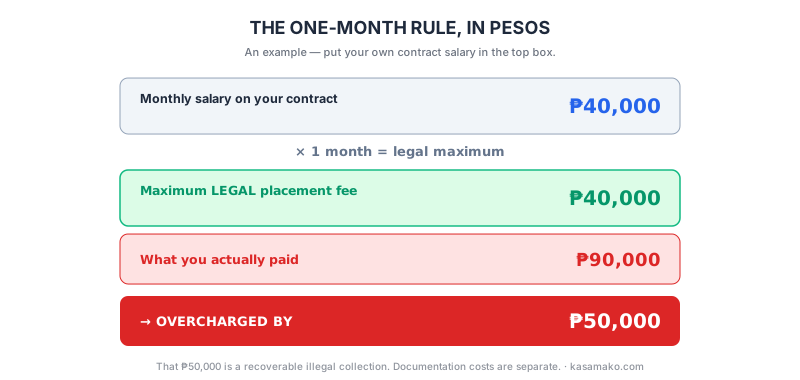
A licensed land-based agency may charge a placement fee no greater than the equivalent of one month’s salary for the job you’re being deployed to — and there are two conditions that matter just as much as the amount:
- Timing. The fee is collectible only after you’ve signed the DMW-approved employment contract. A single peso demanded before that contract exists is illegal, no matter the amount.
- Proof. It comes with a BIR-registered official receipt showing the exact date and amount. No receipt, no legitimate fee.
Let’s put real numbers on it. Say the monthly salary on your contract is ₱40,000:
- Maximum legal placement fee: ₱40,000 (one month).
- You actually paid in placement fee: ₱90,000.
- → You were overcharged by ₱50,000 — and that ₱50,000 is an illegal collection you can move to recover.
Those documentation and government costs from the last section? They sit outside this ₱40,000 cap — but only if they’re real, itemized, and receipted. They are not a license to blow past the limit.
One hard line: a screenshot of “industry standard” rates, or “everyone pays three months for Europe, ma’am,” is not the law. The cap is one month’s salary. Full stop.
One month of the salary you’ll earn — that’s the ceiling. Not one month plus “agency fee,” not “three months because it’s a good country.” If the placement fee you paid is bigger than one month of your salary, the law is already on your side.
The Jobs Where the Placement Fee Is Zero
For a huge share of OFWs, the correct placement fee isn’t “one month.” It’s nothing.
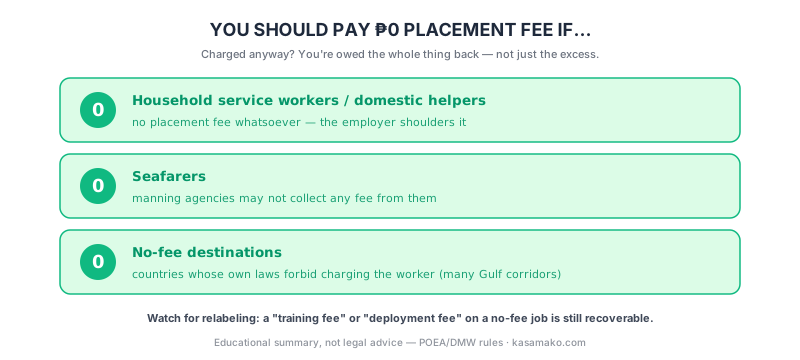
You pay no placement fee at all if you’re in any of these groups:
- Household service workers / domestic helpers. Under the reform that protects domestic workers, no placement fee whatsoever may be charged to HSWs going abroad. The foreign employer shoulders the cost, not you.
- Seafarers. Manning agencies may not collect any placement fee from the seafarers they hire.
- Workers bound for no-fee destinations. The one-month rule applies except in countries whose own laws prohibit charging workers a fee. Many Gulf corridors work this way — the employer pays. The test is your destination country’s policy, so confirm yours before you hand over anything.
Why this matters so much: if you were a domestic worker and you were charged a “placement fee,” you weren’t overcharged by some amount — you were charged something that should have been zero. That’s the cleanest kind of claim there is.
Watch for relabeling. Agencies sometimes disguise an illegal placement fee as a “training fee,” “deployment fee,” or even a “loan.” The label doesn’t make it legal. If it’s the agency’s service charge on a no-fee deployment, it’s recoverable.
For a huge share of OFWs — domestic workers especially — the correct placement fee is zero. If you paid one anyway, you’re not haggling over an amount. You’re owed the whole thing back.
Were You Overcharged? A 5-Question Check
Run your own receipts through these five questions.
- Were you in a zero-fee category — domestic worker, seafarer, no-fee destination — and charged anyway? → overcharge.
- Did you pay more than one month of your salary in placement fee? → overcharge.
- Did you pay any fee before you had a signed contract? → illegal collection, whatever the amount.
- Were you refused an itemized breakdown or official receipts? → red flag; bundling is how overcharges hide.
- Did you pay into a personal e-wallet instead of the agency’s company account? → red flag.
A single “yes” is worth acting on. Two or more, and you almost certainly have a recoverable claim.
And don’t talk yourself out of it because your records are incomplete. Licensed agencies are required to keep records and issue official receipts, so gaps in your paperwork are not the end of a claim — they’re often the agency’s problem to answer for.
How to Get Your Money Back
This is the part most articles skip. Here’s the actual path.
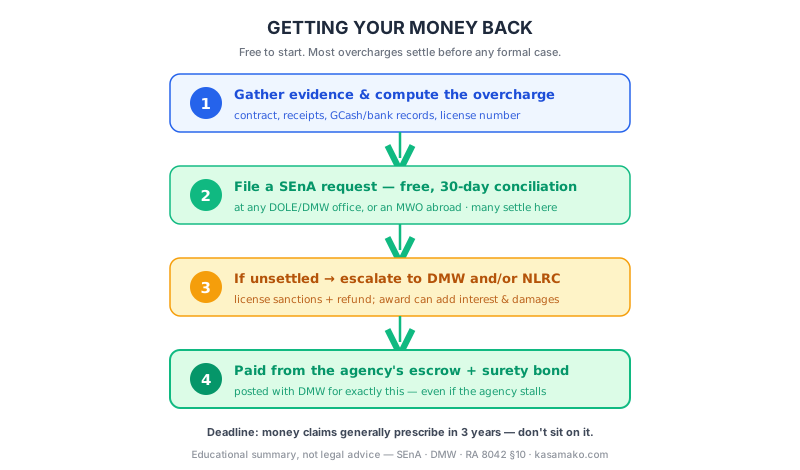
1. Gather your evidence. Your contract, every receipt, GCash or bank records, the agency’s name and license number, and any messages discussing the fee. Partial is fine — gather what you have.
2. Compute the overcharge. What you paid minus the legal cap (or minus zero, if you were exempt). Put a number on the claim.
3. Start with SEnA. The Single Entry Approach is a free, 30-day mandatory conciliation-mediation that expressly covers money claims of any amount and OFW cases. Many fee refunds settle right here, without a formal case. You can request a SEnA at any DOLE or DMW office — or at an MWO if you’re still abroad.
4. Escalate if it doesn’t settle. File a recruitment-violation complaint with the DMW, which can sanction the agency’s license and order a refund of illegally collected fees — and/or pursue the money claim at the NLRC, where an award can carry legal interest, damages, and attorney’s fees. By law, the agency and its foreign principal are jointly and solidarily liable for your claim, and a corporation’s officers and directors are personally liable too — so “the agency closed down” is not the dead end it sounds like.
5. The leverage you didn’t know you had. Every licensed agency posts an escrow deposit and a surety bond with the DMW for exactly this purpose: to satisfy workers’ money claims. A finding in your favor can be paid out of it, even if the agency drags its feet.
Charging more than the cap, or any fee before contract signing, is a prohibited act under RA 8042 as amended by RA 10022 — for a licensed agency it carries 6 years and 1 day to 12 years of imprisonment and a ₱500,000 to ₱1,000,000 fine. That’s the weight sitting behind your refund request.
One timing warning: a money claim generally prescribes in three years from the cause of action. File promptly — an old overcharge can time out.
If the “agency” turns out to be unlicensed, this isn’t just an overcharge — it’s illegal recruitment, and you should report it through the report-and-recover steps in my TikTok scam guide in parallel.
What to Realistically Expect
Two honest things, because you deserve them.
First, the good news: unlike a faceless scammer who vanishes, a licensed agency is regulated, bonded, and reachable. That’s real, structural leverage, and SEnA refunds of overcharges genuinely happen.
Second, the honest news: timelines vary, a foreign principal can complicate collection, and not every peso always comes back. File anyway — it can trigger sanctions that protect the next worker, and it’s the prerequisite for any recovery at all.
And the same warning I give in every guide: beware the “fixer” who slides into your messages offering to recover your money for a cut. That’s a second scam hunting the victims of the first. The real channels — SEnA, the DMW — are free.
A licensed agency overcharging you is not a dead end. It’s the one situation where the rules, the regulator, and a cash bond are all already on your side. The only fatal mistake is assuming nothing can be done and never filing.
Never Overpay Again: The 4-Step Rule
Before you pay any agency a single peso, run four checks:
- Confirm the agency is DMW-licensed — the 60-second license check takes one browser tab.
- Cap it — know one month of your salary; that’s the ceiling (or zero, if you’re exempt).
- Itemize — demand a line-by-line breakdown and an official receipt for every charge.
- Time it — refuse any placement fee before a signed contract.
Confirm · Cap · Itemize · Time. Four steps between you and an overcharge.
Frequently Asked Questions
Is POEA still around? No. POEA was abolished in 2022 and absorbed into the Department of Migrant Workers (DMW) under RA 11641. The placement-fee rules carried over; complaints now go to the DMW.
How much is the legal placement fee? At most one month’s salary for the job you’re deployed to, collectible only after you’ve signed the contract and only with an official receipt. Documentation and government costs are separate and must be itemized.
Do domestic workers pay a placement fee? No. Household service workers / domestic helpers pay zero placement fee — the employer shoulders it. Seafarers and workers bound for “no-fee” destinations also pay nothing.
How do I get a refund from a recruitment agency? Gather your receipts, compute the overcharge, and file a free SEnA request for 30-day conciliation. If that fails, escalate to the DMW and/or the NLRC. The agency’s mandatory escrow and surety bond exist to pay claims like yours.
Is there a deadline to file? Yes — money claims generally prescribe in three years from the cause of action, so don’t sit on it.
What Kasamako Is Building
This is the kind of thing I’m building Kasamako to make trivial. Right now, figuring out whether you were overcharged means knowing the one-month rule, knowing whether your job is fee-exempt, and doing the math under pressure — usually after the money’s already gone.
I want that to be one screen: tell it your job and what you paid, and it tells you the legal cap, whether you should have paid zero, and what to file. It’s in development — no overpromises. If you want to know when it ships, or you want to send me a receipt pattern so I can build the checker around real cases, join the early-access list. No spam, no selling your data.
Resources, Sources, and a Word About Me
Verify and act — the links that matter most:
- DMW — List of Licensed Recruitment Agencies — check the agency before you pay
- DMW main site (formerly POEA) — licensing and complaints
- File a complaint / report: Migrant Workers Protection Bureau — [email protected], or your nearest Migrant Workers Office abroad
- SEnA (Single Entry Approach) — free 30-day conciliation for money claims
Related reading:
- How to Spot an Illegal OFW Recruiter on TikTok — when the agency is unlicensed, this is the report-and-recover pathway
- The 3 Hidden Fees in Every Philippines Remittance Service — the same “know what you should actually pay” muscle
- Contract Substitution: How to Spot Switched OFW Contracts — the contract that proves your real salary, and the cap
- The 40,000 Stranded OFW Crisis: Your Options if Banned — when desperation makes overpaying feel necessary
- Saudi Arabia’s Kafala System in 2025 — what real deployment to the biggest corridor looks like
Kasamako (in development): Join the early-access waitlist
I’m building Kasamako because OFWs deserve clear answers about their own money — especially the money an agency wasn’t allowed to take. I’m a software developer, not a lawyer or a licensed recruitment agency. This article is educational, not legal advice.
Rules note: POEA was absorbed into the DMW in 2022 (RA 11641); the placement-fee rules here come from the POEA/DMW recruitment rules and RA 8042 as amended by RA 10022, accurate as of June 2026. Fee ceilings, exempt-category lists, and complaint channels change — confirm the live DMW site before you act, and consider free DMW or legal-aid help for your specific case.
No affiliate links. No paid placements. No “we’ll recover your money for a fee” services — the real channels are free.
Ingat lagi.
Comments