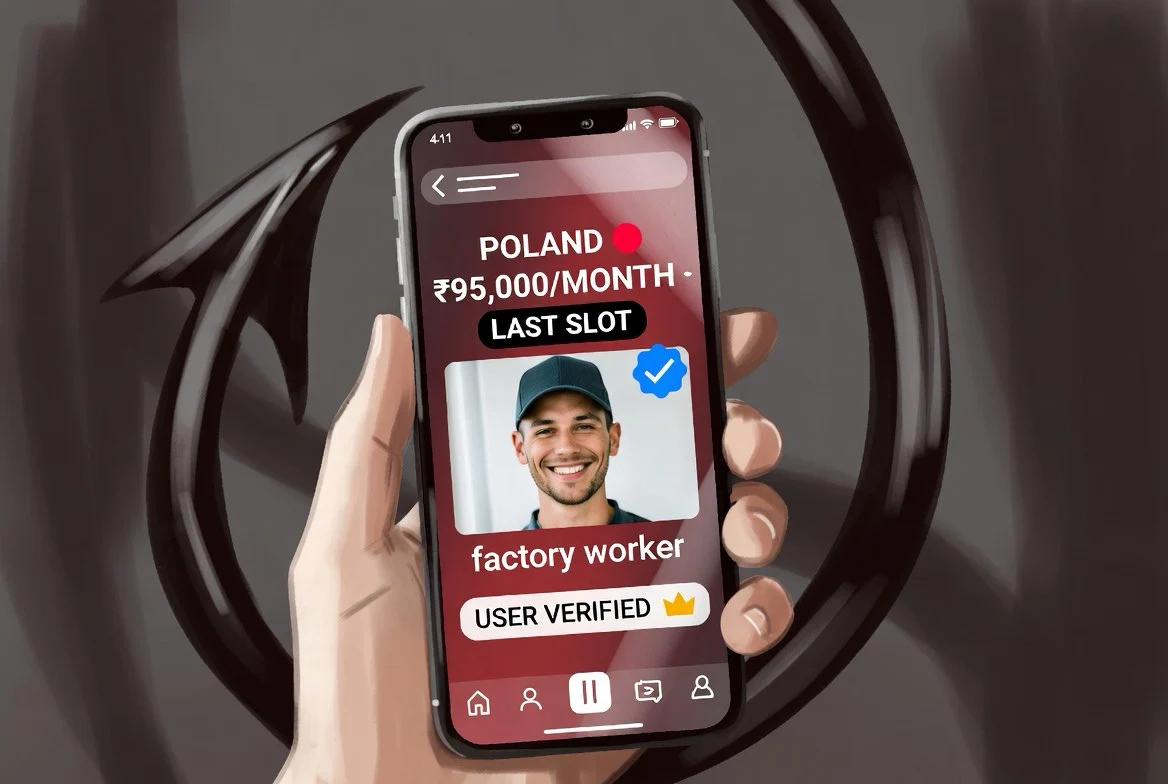
204,428 Posts. And That’s Only What Got Caught.
Between 2020 and 2026, the Department of Migrant Workers took down 204,428 illegal-recruitment posts from social media. Not 204,428 ads. Not 204,428 accounts. 204,428 individual posts — 146,871 on Facebook and 57,557 on TikTok, each one engineered to separate a hopeful kabayan from their money. The figure was disclosed at a Senate Committee on Migrant Workers hearing in May 2026.
And that’s only the ones that got caught.
Here’s the uncomfortable part: the scam that’s coming for you won’t look like a scam. It’ll look like the best news you’ve had all year — a factory job in Poland, ₱95,000 a month, “last two slots, ma’am, reserve now.” The recruiter will be friendly. The video will look professional. The only thing standing between a real overseas job and a trafficking funnel is a 60-second check that almost nobody does.
This guide teaches you that check. We’ll walk through how a TikTok recruitment scam actually works, the seven red flags that give it away, the exact way to verify a recruiter’s DMW license in under a minute, the fees that are illegal for anyone to charge you — and what to do if you’ve already paid.
Jump to what you need:
- Got an offer right now and just want to check it? → The 60-Second DMW License Check
- Already paid someone and worried? → If You’ve Already Paid: Report and Recover
- Want to understand the playbook first? → keep reading.
Take a breath. The skill that protects you is small, learnable, and free.
Why This Is Spiking Right Now
Scams aren’t new. So why is the takedown count climbing, and why now?
Because the supply of desperate applicants is climbing. The 2026 Middle East deployment suspension stranded tens of thousands of OFWs who suddenly couldn’t fly to the Gulf (I wrote a full guide to that crisis here). A deployment freeze doesn’t reduce the number of Filipinos who need to work abroad — it just makes them more anxious, and anxiety is the raw material every recruitment scam is built from.
The scammers noticed. In May 2026, the DMW warned the public that illegal recruiters were directly exploiting the Middle East crisis — selling fake “the-suspension-is-lifting, pay now for a priority Gulf slot” deployments to people who were panicking about lost income.
At the same time, the scams changed shape. They migrated from newspaper classifieds to short-form video and encrypted chat: a polished TikTok reel, then a quiet move into Messenger, Telegram, or WhatsApp where there’s no public trail and no moderation. That’s why the DMW is now partnering with Meta Platforms Philippines and TikTok Philippines to accelerate takedowns — and why even 204,428 deleted posts barely keeps pace.
A deployment freeze doesn’t reduce the number of Filipinos who need to work abroad. It just makes them more desperate — and desperation is the raw material every recruitment scam is built from.
Anatomy of a TikTok Recruitment Scam
The scam isn’t random. It runs the same five-stage playbook nearly every time. Naming the stages is what makes it spottable.
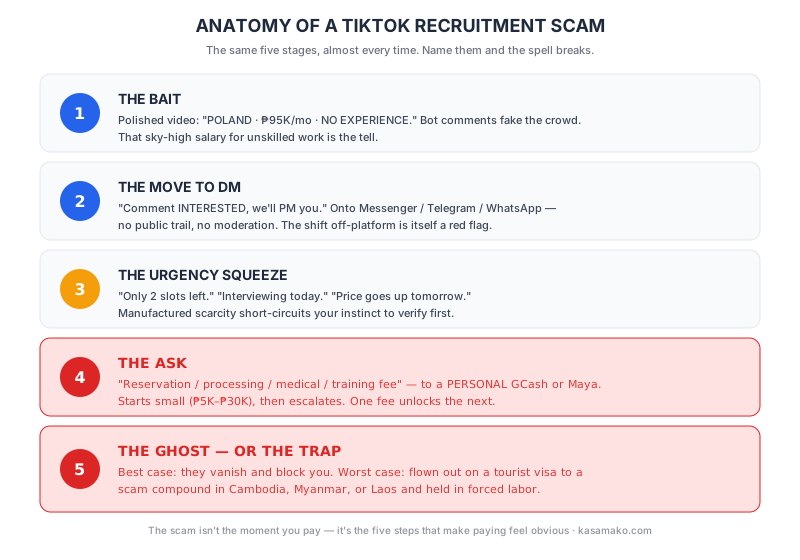
Stage 1 — The Bait. A polished short video: drone shots of a “factory,” smiling “workers,” big on-screen text — “URGENT HIRING · POLAND · ₱95K/MONTH · NO EXPERIENCE.” The comments are full of accounts saying “PM sent po” and “Interested, ma’am.” Many of those are bots, manufacturing the look of a real opportunity that everyone else is already grabbing.
Stage 2 — The Move to DM. “Comment INTERESTED and we’ll PM you.” The conversation leaves the public platform fast — onto Messenger, Telegram, or WhatsApp — where there’s no public comment section warning “scam yan,” and no moderator watching. That shift off-platform is itself a red flag, and it’s exactly what the DMW tells you to avoid: never transact with anyone operating only through social media or private messengers.
Stage 3 — The Urgency Squeeze. “Only 2 slots left.” “The employer is interviewing today.” “The price goes up tomorrow.” Manufactured scarcity is the whole game — it short-circuits the part of your brain that would otherwise say let me verify this first.
Stage 4 — The Ask. A “reservation fee,” “processing fee,” “medical fee,” or “training fee,” paid to a personal GCash or Maya number — never a registered company account. It usually starts small (₱5,000–₱30,000) and escalates: one fee unlocks the next.
Stage 5 — The Ghost, or the Trap. Best case, they vanish and block you. Worst case, you’re flown out on a tourist visa and delivered to a scam or phishing compound in Cambodia, Myanmar, or Laos and held in forced labor. The “factory job in Europe” was never real.
One detail worth sitting with: that ₱90,000–₱100,000 “factory worker” salary was the tell all along. That wage is wildly above market for unskilled overseas factory work. A number that good isn’t an offer — it’s bait.
The scam isn’t the moment you pay. The scam is the five steps that make paying feel like the smart, urgent, obvious thing to do. Learn the steps and the spell breaks.
The 7 Red Flags of an Illegal Recruiter
Here’s the checklist. Each flag is one rule and one reason.
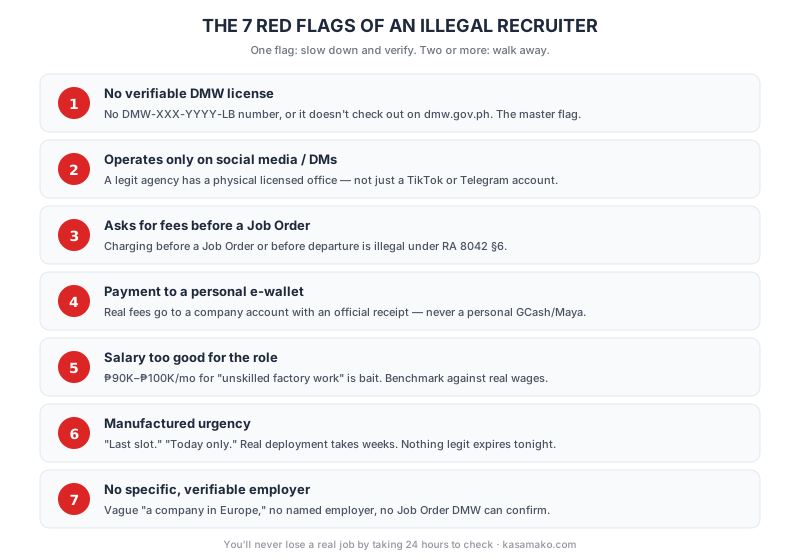
- No verifiable DMW license. They can’t give you a license number in the
DMW-XXX-YYYY-LBformat, or it doesn’t check out on dmw.gov.ph. This is the master flag — the next section shows you exactly how to check. - Recruiting only through social media or DMs. A legitimate agency has a physical, licensed office. One that exists only on TikTok, Telegram, or WhatsApp is operating outside the law — full stop.
- Asks for fees before a Job Order, or before you depart. This is illegal under RA 8042, not just suspicious. More on the law below.
- Payment to a personal e-wallet. Real fees go to a registered company account and come with an official receipt — never a personal GCash or Maya number.
- Salary too good for the role. ₱90K–₱100K a month for “unskilled factory work” is bait. Benchmark any offer against real market wages for that job and country.
- Manufactured urgency. “Last slot.” “Today only.” “Reserve now.” Legitimate deployment takes weeks of documented processing. Nothing real expires tonight.
- No specific, verifiable employer. Vague “a company in Europe,” no named employer, no real address, no Job Order that DMW can confirm exists.
One red flag means slow down and verify. Two or more means walk away. You will never lose a real job by taking 24 hours to check — but you can lose everything by not.
The 60-Second DMW License Check
This is the single most useful thing in this article. A worker who can do this is most of the way to safe.
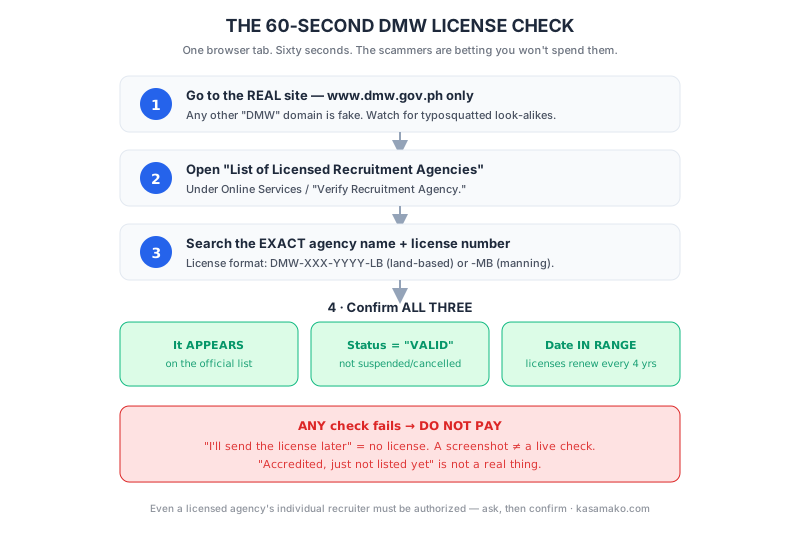
- Go to the real site. Only www.dmw.gov.ph. Any other “DMW” domain is fake — watch for typosquatted look-alikes that copy the design.
- Open the licensed-agencies list. Look under Online Services for “List of Licensed Recruitment Agencies” or “Verify Recruitment Agency.”
- Search the exact agency name (and the license number they gave you, if any).
- Confirm all three: the agency appears in the list, its status reads “Valid” (not delisted, suspended, or cancelled), and today’s date falls within the validity period — licenses renew every four years.
- Cross-check the person. Even a licensed agency’s individual recruiters must be authorized. Ask which licensed agency they represent, then confirm that agency actually vouches for them.
Three hard rules that survive any clever story:
- A license number they’ll “send later” = no license.
- A screenshot of a license is not a live check on dmw.gov.ph. Screenshots are trivially faked.
- “We’re DMW-accredited, just not listed yet” is not a real thing. If it’s not on the list, it’s not licensed.
The DMW has actually shut down agencies — including a Cubao office — caught recruiting on social media without a valid license. The verification list exists precisely because “looked legit on Facebook” has fooled thousands.
You don’t need to be a lawyer to be safe. You need one browser tab and sixty seconds. The scammers are betting you won’t spend them.
The Fees That Are Illegal — By Law
Most workers don’t push back on a fee because they’re not sure what’s allowed. So here it is in plain language — enough to say “that charge is illegal” and mean it.
Recruitment is governed by Republic Act 8042, the Migrant Workers Act, as amended by RA 10022 and strengthened by RA 11641, the DMW Act of 2022. What the law says:
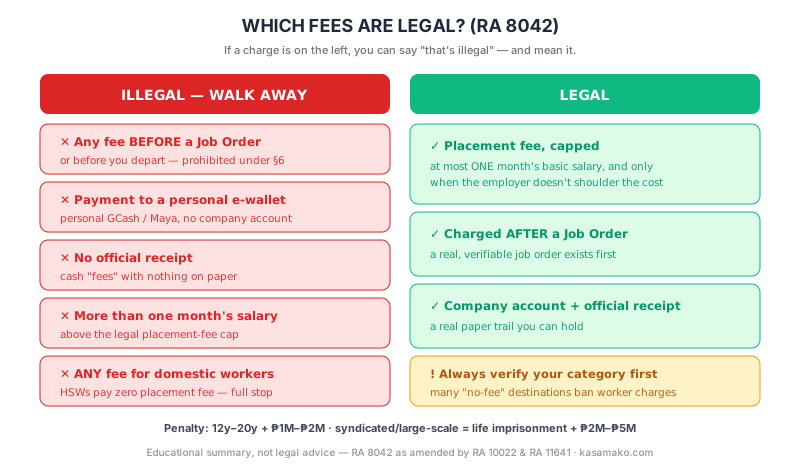
- No fee before a Job Order and before departure. Collecting a placement fee before a valid Job Order is issued and before you actually leave is a prohibited act under Section 6.
- There’s a hard cap. When a placement fee is allowed at all, it’s capped at one month’s basic salary, exclusive of documentation costs — and only when the foreign employer doesn’t already shoulder the cost.
- Some workers pay zero. Household service workers / domestic workers pay no placement fee at all, and several “no-fee” destinations prohibit charging the worker entirely. Verify your category before you pay anything.
- A real fee leaves a paper trail. Official receipt, registered company account — never a personal e-wallet.
So when someone rushes you for a “reservation fee” before you’ve even seen a Job Order, you can say, plainly:
“Charging me before I have a Job Order is illegal under RA 8042. Show me the Job Order and an official receipt, or I’m reporting this.”
And this is real crime, not a gray area. Simple illegal recruitment carries 6 years and 1 day to 12 years imprisonment and a ₱500,000 to ₱1,000,000 fine. When it’s large-scale (three or more victims) or syndicated, it’s classified as economic sabotage — punishable by life imprisonment and a fine of up to ₱5,000,000. The person pressuring you for GCash is committing a serious felony.
For the related fraud that happens after you’ve signed — when the contract you arrive to isn’t the one you agreed to — see my guide on contract substitution. And for the broader habit of knowing exactly what you should and shouldn’t be paying, the hidden remittance fees piece is the same muscle applied to your money.
Why Smart People Still Fall For It
If you’ve been scammed, read this part slowly, because it matters: you were not stupid. You were targeted by professionals.
These operations don’t hunt the gullible. They hunt the hopeful — and every OFW, by definition, is hopeful. The machine is built to exploit that:
- It exploits hope, not ignorance. The more you need the job, the louder the offer’s “yes” drowns out the quiet “verify first.”
- The social proof is manufactured. Bot comments, fake “successfully deployed” testimonial videos, a friend-of-a-friend who supposedly “got in.”
- Urgency disables the checking part of your brain — by design. That’s the whole point of “last slot, today only.”
- Moving to a private DM isolates you. Once it’s a one-on-one chat, there’s no public comment warning you off.
These scams don’t hunt the gullible. They hunt the hopeful — and every OFW, by definition, is hopeful. That’s not a weakness to be ashamed of. It’s the exact thing the scammer is counting on you to feel.
So if it already happened to you, the right response is reporting — not shame. Here’s how.
If You’ve Already Paid: Report and Recover
Came here too late? Move fast, and don’t let embarrassment slow you down.
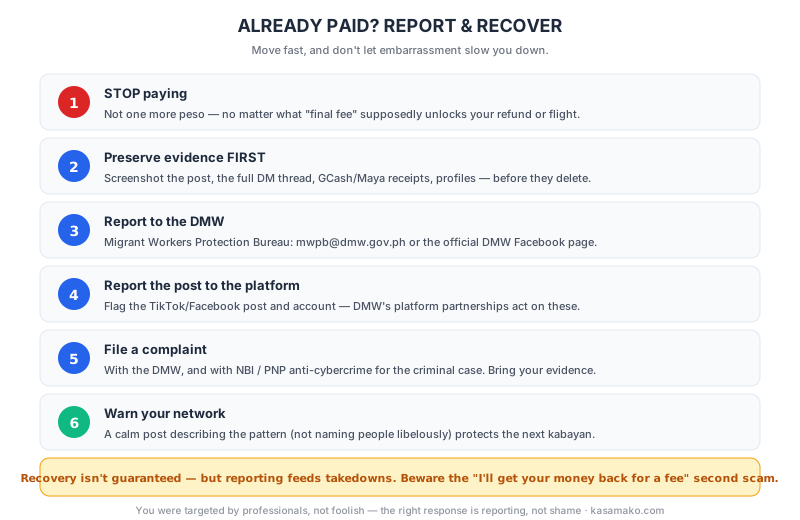
- Stop paying. Not one more peso — no matter what “final fee” supposedly unlocks your refund or your flight.
- Preserve the evidence first. Screenshot everything before they delete and block: the original post, the full DM thread, your GCash/Maya receipts, the recruiter’s profile, every name and number.
- Report to the DMW. The Migrant Workers Protection Bureau takes reports at [email protected] or through the official DMW Facebook page.
- Report the post to the platform. Flag the TikTok or Facebook post and account — the DMW’s Meta and TikTok partnerships act on these reports.
- File a complaint. For the money and the criminal case, you can file with the DMW and with the NBI or PNP anti-cybercrime units. Bring the evidence from step 2.
- Warn your network. A calm public post describing the pattern (not naming people libelously) protects the next kabayan who’s about to comment “interested po.”
Two honest things. First, recovering the money is not guaranteed — many operators are offshore and route payments through mule accounts. Report anyway: it feeds the takedowns, protects others, and is the prerequisite for any case. Second, beware the recovery scam — anyone who slides into your DMs offering to “get your money back for a small fee” is a second scammer hunting victims of the first.
Your 30-Second Pre-Application Ritual
Leave this article with one habit. Before you message any recruiter, before you pay anyone anything, run the four R’s:
- Verify the agency on dmw.gov.ph.
- Refuse any fee before a Job Order and an official receipt.
- Resist the urgency — sleep on it; a real job survives 24 hours.
- Report anything that fails the first three.
Verify · Refuse · Resist · Report. If an offer can’t survive all four, it was never an offer.
What Kasamako Is Building
This is exactly the problem I’m building Kasamako to help with. The hardest part of staying safe isn’t knowing the rules — it’s running the checks when you’re excited and someone is rushing you. I’m working on tools that make verification one tap instead of a 60-second hunt: paste a recruiter’s name or a contract and get a plain-language “here’s what to check before you pay.”
It’s in development. If you want to know when it ships — or you want to send me a scam pattern you’ve seen so I can build detection for it — join the early-access list. No spam, no selling your data.
Resources, Sources, and a Word About Me
Verify and report — the links that matter most:
- DMW — List of Licensed Recruitment Agencies — the one check that protects you most
- DMW main site and DMW Advisories
- Report illegal recruitment: Migrant Workers Protection Bureau — [email protected], or the official DMW Facebook page
Related reading:
- The 40,000 Stranded OFW Crisis: Your Options if Banned — why scams spike during the deployment freeze
- Contract Substitution: How to Spot Switched OFW Contracts — the fraud that comes after you sign
- The 3 Hidden Fees in Every Philippines Remittance Service — knowing what you should actually pay
- Saudi Arabia’s Kafala System in 2025 — what real deployment to the biggest corridor looks like
Kasamako (in development): Join the early-access waitlist
I’m building Kasamako because the OFW community deserves calm, accurate guidance — especially when someone’s trying to rush you into a decision. I’m a software developer, not a lawyer or a licensed recruitment agency. This article is educational, not legal advice.
Numbers note: the 204,428 takedown figure covers 2020–2026 (146,871 Facebook + 57,557 TikTok) and was disclosed at a May 2026 Senate hearing; every figure here is sourced inline and accurate as of June 2026. License-verification steps, fee rules, and DMW contact channels change — check the live DMW site before you act.
No affiliate links. No paid placements. If you’ve seen a scam pattern that isn’t here, email me — naming new modus operandi keeps the next kabayan safe.
Ingat lagi.
Comments